Milwaukee Infusing AI Into 911 Emergency Calls
City hopes artificial intelligence will ramp up speed, quality of responses.
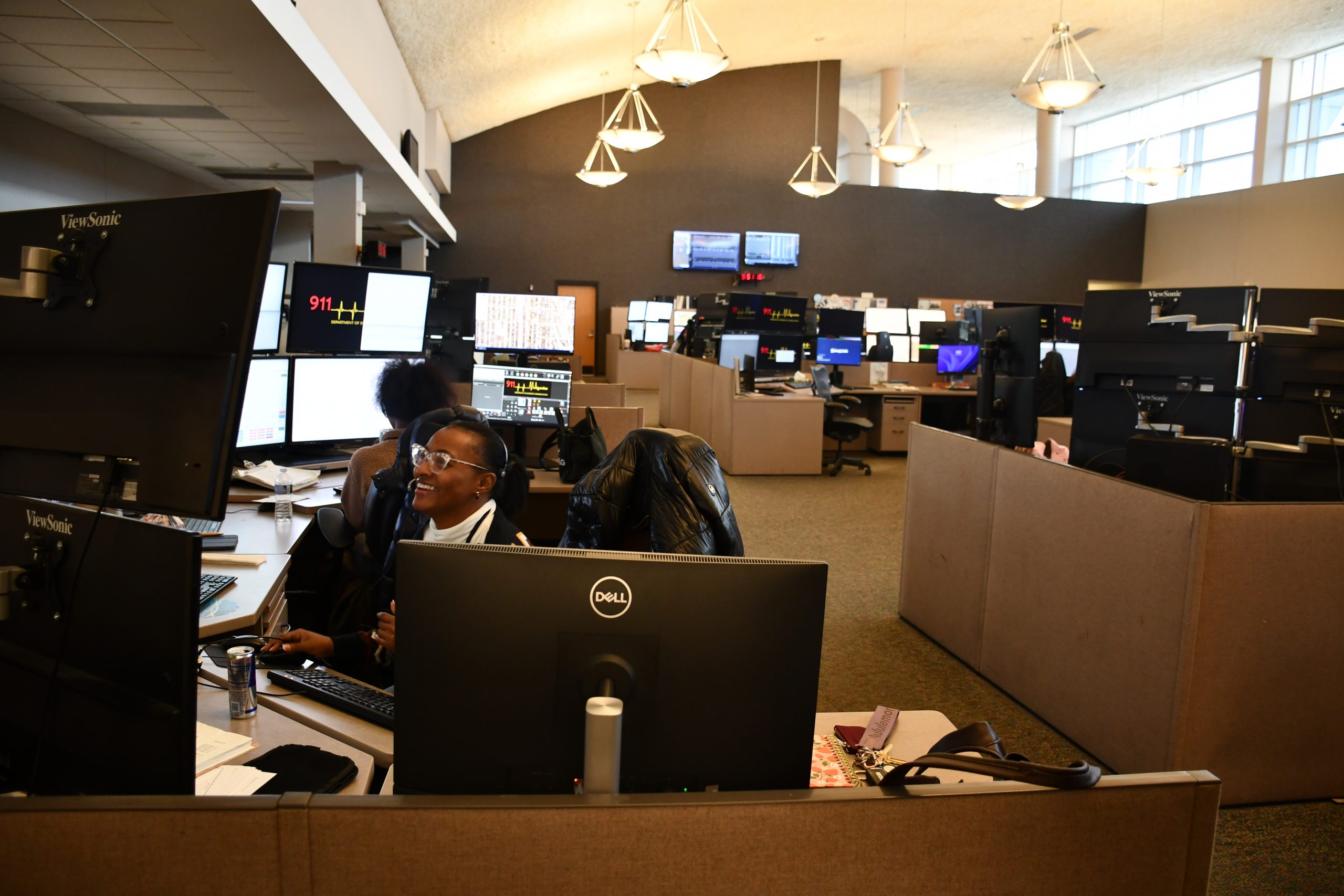
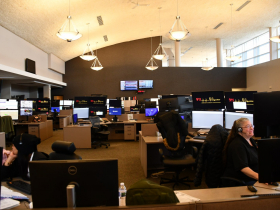
Department of Emergency Communications. Photo by Jeramey Jannene.
This call might be recorded … so a computer can use it to train the operator.
Milwaukee’s 911 call center is now relying on artificial intelligence software to train and evaluate its operators.
It’s something city officials hope will improve the quality and speed of those taking the calls, yielding faster service to those who need it most.
“This was an intentional investment in people, process and accountability,” said Tony Bueno, director of the Department of Emergency Communications, at a press conference Wednesday morning. “We are not turning 911 over to an artificial intelligence platform. We’re not automating emergency call handling. And we are not removing human judgment from life-critical decisions. What we are doing is using technology responsibly to support continuous improvement.”
The new system, CommsCoach, allows trainers to preprogram a scenario and include events operators might face, like a gunshot firing in the background or with crowd noise throughout. It replaces trainers making test calls and banging on the desk to generate sound effects.
CommsCoach will also be used to analyze recordings of every call to provide guidance to operators if they’ve followed their training, including asking questions in the proper order. Trainers previously would select calls at random to analyze.
“What this is about is taking emergency response in the city of Milwaukee to the next level,” said Mayor Cavalier Johnson. “This is not about replacing people.”
“By leveraging technology, it will act as a force multiplier for us. It will raise standards, expand accountability, and do so without increasing taxpayer burden. This is fiscal responsibility and public safety innovation.”
The city has a three-year contract, for $64,000 annually, to use GovWorks’ system. Bueno said the city is paying only one-third of the full price for being an early adopter and one of the largest users. The director said GovWorks was chosen in part for the pricing and how the department has seen the system perform elsewhere.
“I would just point out that that is far less than we would pay eight, 13 additional employees to do the same job,” said Bueno. “It’s about getting the right help to the right place quickly.”
Training Supervisor Jennifer Guetchidjian and Quality Assurance Manager Tristan Brodie said trainers and select operators have spent several weeks programming the system to handle the nuances of how Milwaukee fields 911 calls.
The first class of new operators to go through an AI-assisted eight-week training session is expected to start soon. After completing the standard training, operators spend six weeks on the floor taking real calls with support from trainers.
CommsCoach is not used in real-time during calls. But Bueno said the department is looking at technologies that could do this. “We have other technology that we’ll be announcing later this year that does a lot of real time stuff,” he said. “Just a little teaser there.”
The AI implementation marks the latest change for Milwaukee’s 911 center, located on the top floor of the Milwaukee Police Department‘s District Three station at 4923 W. Lisbon Ave.
Until recently, the city maintained separate but attached police and fire call centers. The bifurcated operation, which involved call handoffs for fire and medical calls, has been merged into the standalone Department of Emergency Communications and, since February, operated as one unified operation.
“We’re baselining our operation, our current performance standards, and we’re building on that,” said Bueno. “Call answer time is an industry benchmark. Ninety percent of our calls to 911 should be answered within 15 seconds, 95% within 20 seconds. And we’ve met that every single month for the past 18 months.”
The setup resembles a Wall Street trading floor, with at least four computer monitors at each desk, low cubicle walls, and dozens of intently focused workers glued to their screens as they talk into headsets.
The department has a $27.2 million budget in 2026.
Photos
Existing members must be signed in to see the interactive map. Sign in.
If you think stories like this are important, become a member of Urban Milwaukee and help support real, independent journalism. Plus you get some cool added benefits.