

Assembly Passes Constitutional Amendments
One would outlaw DIE programs in Wisconsin.
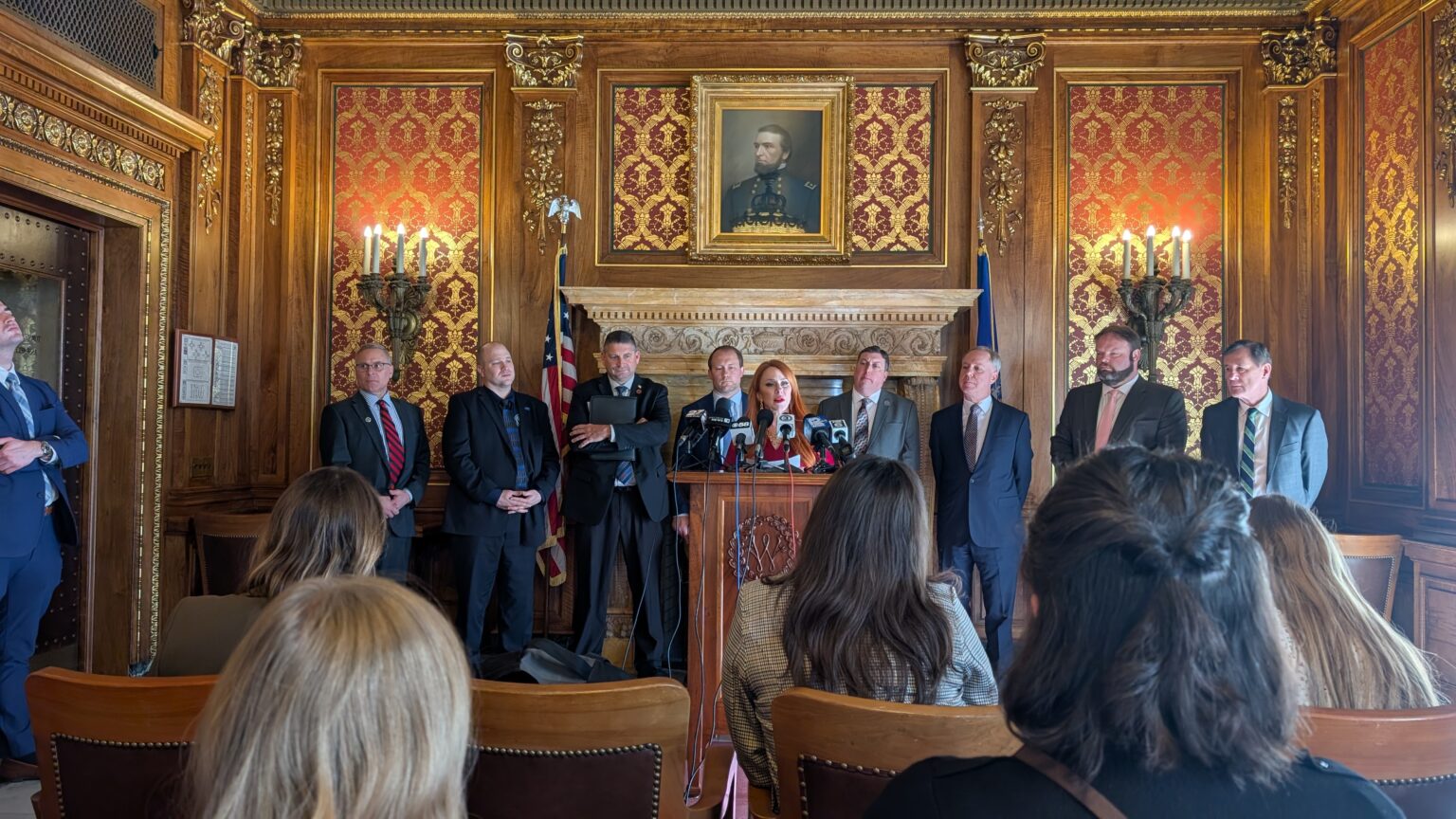
“This is not about vague feelings or misunderstandings,” Rep. Amanda Nedweski (R-Pleasant Prairie) said of her bill to make child grooming a crime. (Photo by Baylor Spears/Wisconsin Examiner)
The Wisconsin Assembly, which met for its first floor session of the year on Tuesday, passed two constitutional amendments that could be on ballots in November as well as bills to withhold pay from suspended judges and to make “grooming” to establish a sexual relationship with a child a felony crime.
For the first time in nearly two decades, the floor session occurred without livestream coverage from WisconsinEye, the nonprofit organization that produces live and archived videos of state government similar to C-Span.
Two constitutional amendments advance
The Assembly passed two constitutional amendment proposals. One would bar the closure of places of worship during a state of emergency and the other would eliminate diversity, equity and inclusion programs throughout Wisconsin.
Each proposed amendment is up for the second of two required votes in consecutive sessions of the Legislature. If they pass the Senate, they will appear on voters’ ballots in November. A majority of voters must approve them before the state constitution can be amended.
AJR 10, which would prohibit the state from ordering the closure of places of worship during a state of emergency, passed 56-43. Rep. Sylvia Ortiz-Velez (D-Milwaukee) joined Republicans in favor of the proposal.
The proposal was first introduced during the 2023-25 session in response to actions taken by the Evers administration during the COVID-19 pandemic. A “Safer at Home” order issued by Evers in March 2020 designated religious entities as essential but said gatherings should include fewer than 10 people in a room at a time and said people needed to adhere to social distancing requirements as much as possible. The order also advised places of worship to have drive-in services.
Only Rep. Ron Tusler, the proposal’s author, spoke about it during the floor session.
“No more than 10 people at a time, no matter how big the church structure was. What part of never infringe the right of every person to worship almighty God, according to the dictates of their conscience, did Gov. Evers not understand?” Tusler asked, referring to the Wisconsin State Constitution. “Evers was wrong to limit our churches to 10.”
Voters would be asked “Shall Section 18 of Article I of the Constitution, which deals with religious liberty, be amended to prohibit the state or a political subdivision of the state from ordering the closure of, or forbidding gatherings in, places of worship in response to a state of emergency, including a public health emergency?”
AJR 102, which seeks to target diversity, equity and inclusion efforts in state and local governments, passed 54-45 with only Republican support.
Rep. Dave Murphy (R-Hortonville) said the proposal will restore “merit, fairness and equality to government practices from the state Capitol, all the way down to our school boards and everything in between” including when it comes to hiring, scholarships and contracting.
Rep. Supreme Moore Omokunde (D-Milwaukee), speaking against the proposal, said it represents an opportunity for Republicans “to rev up voters for November and an opportunity to give red meat to the base.”
Voters across the state could find the constitutional amendment proposals alongside a slate of high stakes races on their ballots in November including a race for governor, congressional races and races for the state Senate and Assembly that will determine control of the chambers in 2027.
Rep. Margaret Arney (D-Wauwatosa) said the anti-DEI proposal creates a roadblock to helping her community.
“We need to do more to have Black and brown kids succeed in Wisconsin,” Arney said. “This change doesn’t help improve well-being in the district. It gets in the way.”
“This is the kind of fairness that the people of Wisconsin are looking for,” Murphy responded.
The proposal now needs to pass the Senate before it can go to voters. If it passes there, voters will see the following question on their ballots in November: “Shall section 27 of article I of the constitution be created to prohibit governmental entities in the state from discriminating against, or granting preferential treatment to, any individual or group on the basis of race, sex, color, ethnicity, or national origin in public employment, public education, public contracting, or public administration?”
Withholding judge’s pay during temporary suspension
AB 380 would require that if the state Supreme Court temporarily suspends a judge from practicing in the state pending final determination of proceedings or imposes a suspension as a disciplinary sanction in a case of misconduct then the suspension must be without pay.
The bill passed 57-42. Rep. Jenna Jacobson (D-Oregon), Rep. Steve Doyle (D-Onalaska) and Rep. Tara Johnson (D-Town of Shelby) joined Republicans in support of the bill.
The bill was introduced last year after the arrest and suspension of former Milwaukee County Judge Hannah Dugan, who has since been found guilty of felony obstruction of federal immigration agents in December and submitted her resignation from her position in January.
Bill coauthor Rep. Shae Sortwell (R-Two Rivers) told reporters before the session that the bill will ensure that “when a judge is suspended for misconduct, they are not being continued to be paid by the people of Wisconsin.”
“Not only is it an extended vacation, which is what Judge Dugan ended up enjoying while she was not doing her job, but in addition to that, we had to have other judges fill the role and get the job done so that cases could continue to be adjudicated in Milwaukee County,” he added. “If another judge decides to do this, they shouldn’t be able to collect their pay, hundreds of thousands of dollars, while that case is pending.”
Sortwell also said an amendment to the bill will ensure that should a judge be found not guilty they would receive backpay.
During floor debate, Rep. Andrew Hysell (D-Sun Prairie) called it a messaging bill given that it wouldn’t have applied to Dugan. He pointed out that the statute that the bill would change was not used by the state Supreme Court when it suspended Dugan.
“It would have saved taxpayers zero dollars,” Hysell said. “I understand that certain bills are meant to convey certain messages to the public, but even a messaging bill should have some arguable connection to the underlying problem that it supposedly fixes.”
Sortwell said that Hysell was right it wouldn’t have affected Dugan, but reiterated that his bill is looking towards the future.
“We do believe in innocence until proven guilty,” Sortwell said. “She was found to be guilty and good riddance to her.”
Grooming a crime
The Assembly also passed AB 677, which would make grooming a felony crime in Wisconsin, in a 93-6 vote. Reps. Ryan Clancy (D-Milwaukee), Angelina Cruz (D-Racine), Francesca Hong (D-Madison), Christian Phelps (D-Eau Claire) and Angelito Tenorio (D-West Allis) voted against the proposal.
Bill author Rep. Amanda Nedweski (R-Pleasant Prairie) said the bill will help protect children and noted that she started working on the bill about 18 months ago due to the case of Christian Enwright, a former Kenosha teacher who pleaded guilty last year to over a dozen misdemeanor counts of disorderly conduct after he had an inappropriate relationship with a 14-year-old student.
“Anyone who followed that case and saw the messages that Enright sent would know that his behavior is far more than disorderly. Because of the lack of a criminal definition of grooming, that was all he could be charged with,” Nedweski said.
Under the bill, grooming in Wisconsin would be defined as “a course of conduct, pattern of behavior, or series of acts with the intention to condition, seduce, solicit, lure, or entice a child for the purpose of producing distributing or possessing depictions of the child engaged in sexually explicit conduct.”
A person convicted of a grooming charge, under the bill, would be guilty of a Class G felony. The charge would increase to a Class F felony if the person is in a position of trust or authority, and to a Class E felony if the child has a disability and to a Class D felony if the violation involves two or more children. A convicted person would need to register as a sex offender.
An amendment to the bill would change the crime to a Class I felony if the person convicted of the crime is a school staff member or volunteer.
“This is not about vague feelings or misunderstandings. There needs to be a pattern of predatory behavior with the intent to have sexual contact with the victim,” Nedweski said. “This bill came as a result of months of conversations with law enforcement prosecutors, district attorneys, educators and victim advocates.”
Assembly Minority Leader Greta Neubauer (D-Racine) said in a statement that she appreciated the bipartisan effort on the bill.
“We all share a commitment to protecting kids in school and ensuring they can safely learn and grow,” Neubauer said. “This is a critical issue, and I hope we will continue working together to support and protect our kids.”
Assembly’s first time on the floor without WisconsinEye livestream
Ahead of the Assembly floor session, Neubauer called the absence of WisconsinEye as lawmakers continue their business this month an “unsustainable situation.” The nonprofit organization ceased coverage and pulled its archive offline on Dec. 15 due to financial difficulties.
“It is not a good day for accountability to the people who elected us to serve them,” Neubauer said. “Transparency is an essential part of a functioning democracy. Without it, mistrust thrives and multiplies at a time when we need to be building trust in state government. We need to be demonstrating that government can and must be a force for good. This is a step in the wrong direction, and it erodes the public’s trust in this institution.”
Neubauer said she is open to negotiating with her Republican colleagues to find a solution. She said that lawmakers did not set the organization up for success with the match requirements placed on the $10 million that the state set aside for an endowment.
“Not sure that a $10 million requirement was ever really realistic for WisconsinEye. We would of course like to see more fundraising,” Neubauer said.
Neubauer and Democrats also questioned why Republican lawmakers were not working more quickly towards a solution as well as why they began enforcing a ban against members of the public who try to record committee proceedings.
“I would ask that you ask yourself what kind of politician doesn’t want for a camera to film what we are doing. What kind of intentions does that politician have? What kind of motivations do they have? What do they have to hide? Why are they doing that?” Rep. Mike Bare (D-Verona) told reporters. “We’re doing important work. People ought to be able to see what we’re doing.”
Gov. Tony Evers told reporters on Monday that he is open to exploring options for getting WisconsinEye back online, but isn’t supportive of just giving the nonprofit state funds without a match requirement.
“I think there has to be some skin in the game,” Evers said of WisEye.
Republican leaders have also said that they support improving transparency but expressed some concerns about giving the organization state funds.
In November, before WisconsinEye went dark, the organization’s president Jon Henkes told the Examiner that the board hadn’t raised any money. He said then that the organization had been reaching out to potential donors about providing large-sum contributions
“We’re not asking for $5,000 gifts right now. We’re asking for gifts in the $50,000 [to] $500,000 range and that’s a limited amount of people out there,” Henkes said in November.
The organization started seeing more small-dollar donations in December.
“Small gift fundraising… through online and small checks that have been arriving in the mail are helpful. They don’t get us where we need to be, but it’s a statement that it’s not just the lobbyists and elected officials around the state in the news media who are supporting us there,” Henkes said in December. “There are a lot of people who are citizen viewers who recognize the value of WisconsinEye and are taking the time to go online to make a small gift or send a check, and we’re very grateful for that. That’s a huge encouragement to us.”
WisconsinEye has increased its attempts to raise money from small-sum donations, including by launching a GoFundMe campaign on Monday. As of Tuesday, the campaign had raised more than $8,000 from over 100 donations. The goal is $250,000, which would help support three months of the organization’s operational costs.
Assembly passes constitutional amendment, child grooming proposals was originally published by the Wisconsin Examiner.
If you think stories like this are important, become a member of Urban Milwaukee and help support real, independent journalism. Plus you get some cool added benefits.



















Notice how the Republican legislature didn’t do much of anything last year, and now that WisconsinEye is gone they’re starting to work? I bet it’s not a coincidence.
Constitutions should be for broad guidance such as structure of government, statements of principles, basic rules (e.g.: age minimums to hold office), etc.. They should not be cluttered with politically motivated administrative minutiae.
i see we should allow churches and other places of worship to have masses of people infecting each other and then leaving that place to infect everyone they come in contact with during a health crisis and pandemic. there is nothing special about places of worship; the safety of the community is.
“And Almighty Gawd sayeth unto the holier-than-thou Wisconsin State Assembly…YOU SHALL INSIST THAT PLACES OF WORSHIP TO ME (or others similar to me) BE OPEN TO ALL, REGARDLESS OF THEIR HEALTH STATUS, AT ALL TIMES.
By merely including these word into a referendum I, and the state, shall guarantee that no earthly disease shall befalleth the true believers, nor their neighbors who packeth said establishments not unlike sardines, especially if they weareth red baseball caps with writings that dost endorse the Nation in which they liveth (vaguely) and the insistence that it becometh much better than it already is!
Thus sayeth the Lord!”
Who-hoo, it’s clown time in Mad City! These do-nothing MAGA slugs are show-boating, not legislating- which is above their capabilities. I can see the Koch/Uihlein funded ads already. Why don’t you do something about PFAS instead?
Let’s be very clear about the Constitutional ban on diversity, inclusion, and equity programs, would enshrine white supremacy, into the Wisconsin Constitution. This is racist and classist. It does not establish a “meritocracy.” It ensures that who you know is far more important than what you know. It discriminates against those who are different, whether different because of race, ethnicity, gender, disability, sexual orientation, age and class. No doubt, it will be challenged, which will cost $ millions. Those costs will be borne by Wisconsin taxpayers.
This constitutional amendment proposal is nothing more than dog-whistle politics meant to incite fear and hatred into the 2026 elections. RRRs (radical reactionary republicans) have a dismal record upon which to campaign. They are gearing up for a massively negative campaign because they have done nothing to make the lives of Wisconsinites better.