S. 2nd Street Redesign Approved by the Common Council
Dec 23rd, 2009 | By Dave Reid | Category: S. 2nd Street
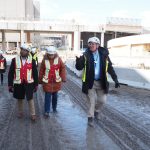
The proposed improvement of S. 2nd Street, in Walker’s Point, was up for approval at the December 22nd meeting of the Milwaukee Common Council. The improvement would involve a complete street reconstruction, narrowing the street to 50 feet from 58 feet, reducing the street to one travel lane in each direction, widened sidewalks, bike lanes, street trees, improved lighting, and other amenities designed to make the street more appeal to pedestrians. Despite the project having support of the two local Alderman that represent the area and the majority of neighborhood stakeholders, Alderman Dudzik made a last ditch effort to halt the project by making a motion to send the file back to committee. In what was a transparent attempt to kill the project, he complained about process at one point saying “I don’t believe that there was an extensive debate.”
In response to Alderman Dudzik’s motion, Alderman Bauman explained that the Department of Public Works, the Department of City Development, the Milwaukee Metropolitan Sewage District and even the Wisconsin Department of Transportation had endorsed the project. MMSD supported the project both as a entity located on S. 2nd Street, and because the plan fits within MMSD’s storm water management principles. Defending the process involved Alderman Bauman stated, “understand there have been numerous neighborhood meetings,” and went on to say in regards to the motion to send back to committee “what new information our we going to garner? No information.”
Alderman Witkowiak responded to the motion explaining that “it was a long process,” and that “it’s clear that my vote remains in support of this project.” He also pointed out that votes taken by the local neighborhood association put support for project at about 75%. He went on to point out that “2nd street is already restricted before you get to Greenfield,” indicating S. 2nd Street doesn’t actually act as an arterial, because it narrows at Rockwell anyhow.
Alderman Dudzik’s motion failed on a 5 to 9 vote, and the subsequent vote on the committee file was approved leaving only Mayor Barrett’s approval before Milwaukee can move forward on the redevelopment of S. 2nd Street.
Weekly Bookmarks – Monday, 21. December 2009
Dec 21st, 2009 | By Dave Reid | Category: BookmarksUpcoming Events for the Week of December 21st, 2009
Dec 20th, 2009 | By Dave Reid | Category: Weekly EventsUrban Milwaukee’s Upcoming Events & Meetings Calendar should help you keep up to date on important events effecting our neighborhoods, the City of Milwaukee, and our region.
-
December 21, 2009
-
December 21, 2009 2:00 pmThe Steering and Rules committee, which consists of the Council President and the chairs of the other standing committees, formulate polices and rules for the Common Council, oversees charter schools, and considers extraordinary matters affecting multiple committees.[...]
-
December 22, 2009
-
December 22, 2009 9:00 amCity Hall
200 East Wells St.
Common Council Chambers
Milwaukee, WI 53202[...]
Special Steering and Rules Committee Meeting
Dec 20th, 2009 | By Dave Reid | Category: EventsThe Steering and Rules committee, which consists of the Council President and the chairs of the other standing committees, formulate polices and rules for the Common Council, oversees charter schools, and considers extraordinary matters affecting multiple committees.
City Hall
200 East Wells Street, Room 301-B
Milwaukee, WI 53202
Common Council Meeting
Dec 20th, 2009 | By Dave Reid | Category: EventsCity Hall
200 East Wells St.
Common Council Chambers
Milwaukee, WI 53202
Water for Waukesha?
Dec 18th, 2009 | By Dave Reid | Category: Lake Michigan, WaukeshaWaukesha has been working towards obtaining a diversion of Lake Michigan water from the City of Milwaukee, purportedly because Waukesha has an issue with radium in their water supply due to depletion of their well water levels to an unsustainable level. The question of selling Great Lakes water to communities outside of the Great Lakes Basin is one that demands numerous questions be answered prior to any diversion being allowed. The request needs extra scrutiny because it would be the first request of its kind handled under the recently past Great Lakes Compact. Furthermore, any community considering participating in a transaction like this one, must look at the potential environmental impacts, and protect its own self interest, while also attempting to balance the region’s interests.
A water diversion brings with it concerns about waste water handling, return flow, and the potential impact on river systems. Waukesha’s current plan involves dumping treated water into Underwood Creek, instead of building return flow infrastructure. This might be a workable solution, but raises questions regarding the impact on water quality and potential flooding. Further, the current plan would discharge water into the Fox River during high flow periods, which would result in water flowing away from the Great Lakes Basin. This in itself might be a violation of at least the spirit of the Great Lakes Compact. Before Milwaukee enters into this transaction it should insure that all water is safely returned to the Great Lakes Basin, to protect not only Lake Michigan, but Milwaukee.
The level of radium in Waukesha’s water might be the short-term reason behind the need for a diversion, but this request is actually about Waukesha’s growth. Waukesha currently uses approximately seven million gallons of water a day, and current predictions suggest that once the municipality is built-out it will require eleven million gallons a day. Without access to clean safe water a new subdivision has no value, industry won’t locate there, and economic development will come to a halt.
Access to water is one of Milwaukee’s strengths, and has historically played a role in its economic growth. Breweries, tanneries, and more recently bottling companies have located in Milwaukee because of the availability of water. Selling water is essentially the selling off of one of Milwaukee’s core assets, it involves costs, and potentially lost economic opportunities. It’s not to say that this should preclude a diversion, just that these opportunity costs need to be recouped. Be it in improved transit service between the two cities, improved sharing of the affordable housing load, or simply in dollars, Milwaukee must consider the cost and determine the true value of water before completing this deal.
Friday Photos Friday, 18. December 2009
Dec 18th, 2009 | By Dave Reid | Category: Friday PhotosJackson Square Apartments
Jackson Square Apartments
Corcoran Lofts
Corcoran Lofts
The Park East Disaster? No
Dec 15th, 2009 | By Dave Reid | Category: Aloft, Park East Square, The Brewery, The Moderne, The North End
Would Milwaukee be better off with the Park East Freeway spur intact? No. Has development been slow so far? Yes. Is that a problem? Only if you have a short-term perspective on the future of Milwaukee.
So we should ask if the Park East Freeway spur was worth keeping or is the long-term benefit more worthwhile than the long-term costs. One of the big concerns regarding the removal of the Park East Freeway spur was that congestion would increase, but the numbers show that traffic delays peaked after the removal and have settled back to 2001 levels, the last full year of regular operation of the freeway spur. Access to downtown Milwaukee has actually been improved, because the new street level boulevard allows drivers to turn on to more streets than the freeway spur allowed. Simply, looking at it from a cost point of view, the freeway spur’s repair costs at the time of its removal were estimated at $100 million, clearly this is significantly more expensive to maintain than a street level boulevard. From a tax base point of view, the freeway limited development of property, not just under it, but near it, and although it has yet to develop, the potential is at least there, and some neighboring properties have added to the tax base.
The big complaint in regards to the Park East is that development has been slow to take hold in the area. Unfortunately, there is truth to this, but looking at the edges of the Park East corridor it is clear investment is starting to take hold. Developments such as the North End, the Flatiron, the Aloft, the Brewery, and the soon to break ground Moderne are a direct result of removing the Park East Freeway spur. These would of been undesirable sites to develop, because of limited access, a perceived disconnect from downtown, and the blighting influence of locating in the shadow of a concrete ramp. Finally, Milwaukee has already proven it can fill-in underutilized land. The Park East Freeway was supposed to extend to the lakefront and the land was cleared for it, but the freeway never happened and the land sat vacant for years (east of the spur that was built). That land now contains a long stretch of residential apartments, a Pick ‘n’ Save, and fits in the neighborhood fairly well. It’s unfortunate that this land was ever cleared, but it shows Milwaukee can reclaim once underutilized land and can do it again.
There is no question that there are a number of factors that have slowed development in the Park East. The lot sizes that Milwaukee County is attempting to sell are too large, which limits the number of developers able to participate and forces the scale of the development to a point that requires very significant financing. It’s also possible Milwaukee County’s PERC regulations have limited the number of developers interested in developing within the Park East. Further, these regulations may have played a role in developers requesting TIF’s from the City of Milwaukee to finance projects, though the existence of a direct relationship isn’t clear. The problem that has come up more than once is developers having to deal with two levels of government with differing goals. A clear example of this is RSC & Associates’ Park East Square proposal. Milwaukee County closed on the land sale, despite RSC & Associates lack of financing, fluctuating plans, and continued attempts to gain City of Milwaukee financing for the project.
The opportunity lost had Milwaukee not removed the Park East Freeway spur was simply too great to miss out on, but it does seem it’s time for Milwaukee County to get out of the way and allow the City of Milwaukee to control the land in order to expedite development.
E. State St. Going Two-ways! Almost.
Dec 14th, 2009 | By Dave Reid | Category: East Town, Juneau Town, Yankee Hill
As key component of the downtown plan the City of Milwaukee set a goal of returning streets in the downtown area to two-way traffic. The idea is to make a street more pedestrian friendly and more logical for drivers. Making a street two-ways makes a street more convenient, can slow speeding traffic, and allows for more access and routes to be taken. The idea certainly is not to add as many odd quirks and novelties as possible. As part of this plan, efforts have been underway for years now to slowly convert State St. to two-ways, and fortunately another piece of the section of street will soon be added, the section of E. State St. from Van Buren St. to Market St.
Unfortunately, the design for the E. State St. leaves much to be desired, as the plan looks to have three significant short comings. Specifically, the potential for some parking lanes to be used as travel lanes during “peak” traffic hours, the lack of bike lanes on much of the street, and most critically having the two-way conversion end at Market St., instead of Water St., is wrought with issues.
The peak hour parking ban, which would allow for temporary travel lanes, adds issues for drivers and pedestrians, and points out an issue with the design process. On-street parking is important for pedestrians as parked cars create a safety barrier for pedestrians, essentially creating the feeling that the cars are a wall. As far as drivers this would, albeit temporarily, remove parking from the street, but it would also put traffic at the curb which isn’t common in Milwaukee, and could add confusion. Finally, in regards to the design process ideas like this prioritize a few minutes out of the day over the users throughout the vast majority of the day. It indicates this design came about much like developers plan parking lots for Target. They plan, and therefore spend, for the extreme end points and not for regular use.
Another issue with the plan is the lack of bike lanes. Certainly the road should not be widened to accommodate bike lanes, as it is plenty wide right now, but if bike lanes can be added from Prospect Ave. to Van Buren St. it seems reasonable they could be added all the way to Water St., or in this case Market St. As adding bike facilities when streets are being re-done is the most cost efficient time to do so, it seems this could be a lost opportunity.
As problematic as the these issues are the worst issue of this design is the conversion stopping at Market St. Unfortunately, the motivation behind stopping the conversion at Market St. is in itself a cause for concern, because it is clear that this has nothing to do with good design and everything to do with political pressure. It is evident that the lone opposition to make E. State St. two-ways was MGIC Corporation, and it certainly appears that last minute arm twisting dramatically altered the design. The concern here, is that as the long term goal is make State St. two-ways throughout downtown does this concession now preempt the city from finishing the job in the future?
Hopefully this is just a temporary setback and when the next phase of State St. is prepared to go to two-ways these issues can be corrected.