DPI Hopes Federal Grant Will Help Address Shortage of Special Education Teachers
Half of Wisconsin’s special education teachers quit after 8 years. $10.5 million grant could help.
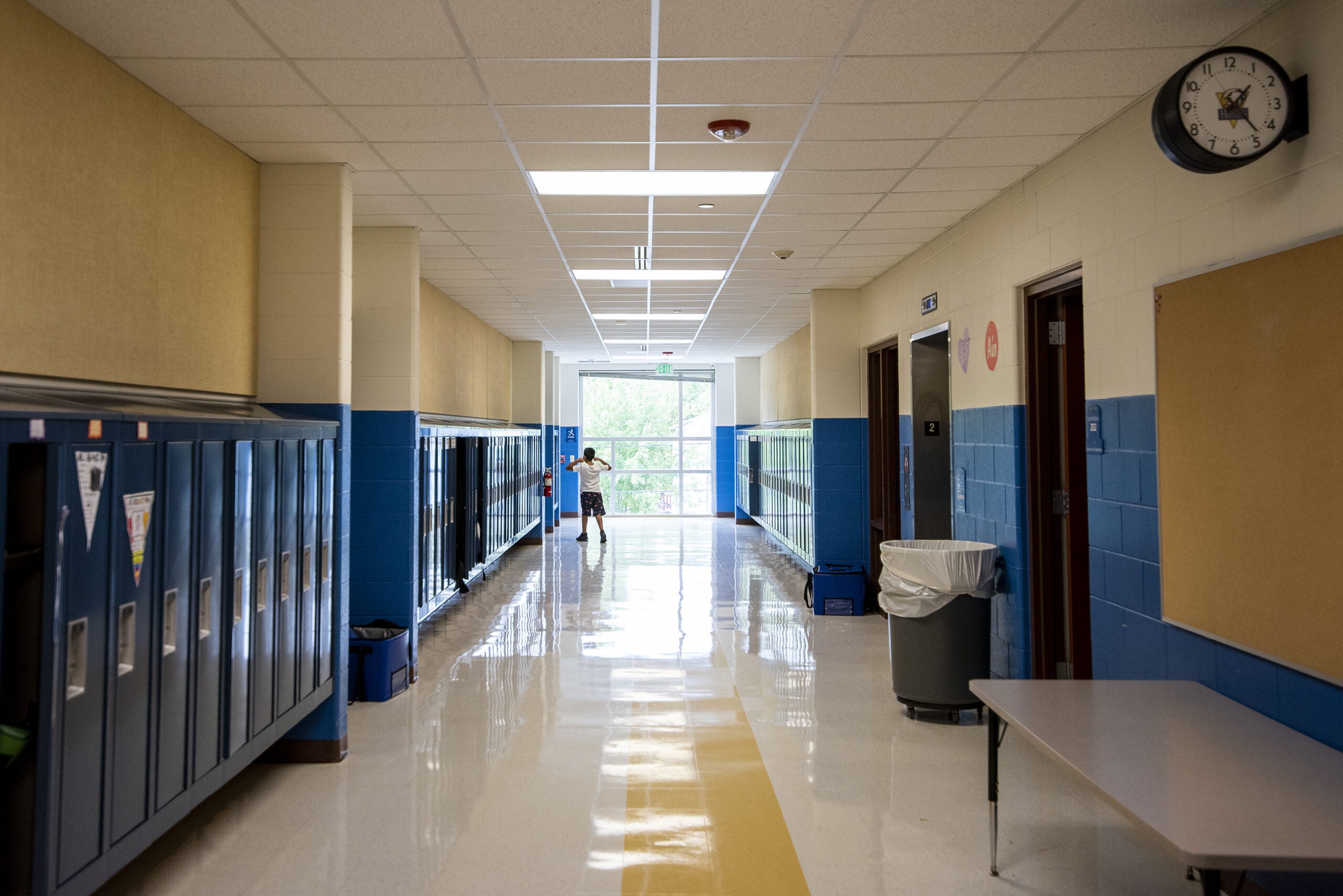
A student walks down a hallway with lockers Friday, Sept. 17, 2021, at Hackett Elementary School in Beloit, Wis. Angela Major/WPR
Fewer than half of Wisconsin’s special education teachers remain in the profession after eight years, according to an April report from Wisconsin’s Department of Public Instruction.
On Aug. 17, DPI announced being awarded a $10.5 million federal grant that the department hopes will help address a critical shortage of special education teachers in Wisconsin.
Barbara Van Haren, the grant proposal’s author and a DPI education development consultant, told WPR’s “Wisconsin Today” that the ongoing high levels of attrition among special education teachers is a crisis.
“Our districts struggle on a regular basis to be able to fill positions, but more importantly, to be able to retain the educators that they have,” she said.
DPI will largely apply the grant to fund the statewide Special Education Teacher Apprenticeship and Induction Retention System: to boost apprenticeships for aspiring special education teachers and help eliminate burnout.
Van Haren said that some special education teachers are switching to work in general education, and burnout is causing many to drop out of teaching entirely.
Over the next five years, Van Haren explained, the $10.5 million grant will help boost resources for first-year teachers and their mentors.
On “Wisconsin Today,” Van Haren talked about the challenges facing special education teachers, how school districts are reacting to the shortage and what she hopes the grant will allow the state to do to address the issue.
The following interview was edited for brevity and clarity.
Rob Ferrett: Special education funding has been a big issue in Wisconsin budget cycles over the last few years. Remind us how special education is funded and where we are today with that support for districts?
Barbara Van Haren: Special education has a couple of funding sources. Our districts receive Individuals with Disabilities Education Act entitlement dollars to support their special education services and also receive categorical reimbursement that comes back into the district for the dollars that have been spent toward special education.
However, we know those two funding sources do not meet the needs of our students with disabilities fully. Often, districts need to be able to then come up with their own resources to fill in those gaps.
RF: What are we doing when it comes to apprenticing those incoming special education teachers to, hopefully, set them up so that they’ll stick around in the long run?
BVH: Apprenticeship has been more readily utilized in business and industry, and seems to be more emerging in the area of education. But we know that apprenticeship is one of those strategies that can really make a difference, not only in recruitment but also in retention.
Wisconsin has had what we call a registered teacher apprenticeship program, or a learn-while-you-earn model, that’s been predominantly utilized for elementary and middle school educators. We have not had one specific to special education. But this grant gives us that opportunity to provide the funds, the structure and coordination necessary to expand it into the field of special education.
RF: Is the lack of special education teachers an especially big concern in our smaller, rural districts in Wisconsin?
BVH: There’s often a desire to grow your own, right? We have promising paraprofessionals or others that might be already rooted in the community, but they might be in a small rural district where there’s really what we call “higher ed desert.”
There isn’t easy access to be able to go back to school, get that degree, get the necessary license and certification. And I think our small rural schools struggle with that to a great degree. They also don’t always have the flexibility or the infrastructure to be able to cover and provide that kind of release time and mentorship. We’re hoping with this grant we’ll be able to offer that financial and organizational support to make it happen.
RF: If you don’t have enough special education teachers, their caseload is larger, their work is more difficult and that causes them to leave the field. Are you seeing this grant as an opportunity to turn that around — spread out that caseload, make the job more attractive and something people can stay in without burning out?
BVH: This is not just about filling vacancies. This is about bringing in really well-prepared individuals with the right tools in their toolkit for the classroom and getting them to actually have greater confidence, and be able to then feel that success and stay.
We’re stopping the revolving door. If we bring in someone inexperienced and they have a bumpy start to their career, they’re more likely to leave. We turn around and then just bring in another individual that may not be readily prepared for that classroom. This is an opportunity to stop that revolving door, to not only recruit and bring in more special educators, but keep those educators in their positions.
RF: How does somebody who’s ready to get into special education connect with these kinds of resources the state offers?
BVH: While it’s a demanding job, I can’t think of a more rewarding job. And these opportunities come through their school districts. If they’re applying to school districts, they’re able to connect with their school district, who in turn can reach out to their local Cooperative Educational Service Agency, or CESA. And in the case of apprenticeship, we’ll be working with the University of Wisconsin-Madison, and they’ll be able to access that apprenticeship program through UW-Madison. Those are opportunities that are there for them.
I think it’s important for them to know that when they are entering the field, they are supported. They have individuals, they have mentors, they have coaches that are available to them to ensure their success and the success of their students.
DPI hopes federal grant will help stop ‘revolving door’ of Wisconsin special education teachers was originally published by Wisconsin Public Radio.
If you think stories like this are important, become a member of Urban Milwaukee and help support real, independent journalism. Plus you get some cool added benefits.