

American Transmission Co., We Energies Seek State Approval for Data Center Costs
Will it protect customers from paying for Mount Pleasant data center? 'The devil is in the details.'
![High Voltage Power Lines. Photo by Corey Coyle [CC BY 3.0 (http://creativecommons.org/licenses/by/3.0)], via Wikimedia Commons](https://urbanmilwaukee.com/wp-content/uploads/2017/04/ATC_High_Voltage_Power_Lines_-_panoramio.jpg)
High Voltage Power Lines. Photo by Corey Coyle (CC BY 3.0), via Wikimedia Commons
Late last month, American Transmission Co. and We Energies filed an application with the Public Service Commission of Wisconsin seeking approval of a transmission charge agreement for Microsoft’s data center in Mount Pleasant.
It comes as ATC is planning more than $2 billion in transmission infrastructure projects tied to data center developments across Wisconsin. Those range from new high-voltage power lines and substations to upgrades to existing facilities.
The proposal is the first in a series of agreements aimed at making sure customers aren’t on the hook for transmission costs for data center projects, including others in Port Washington and Beaver Dam.
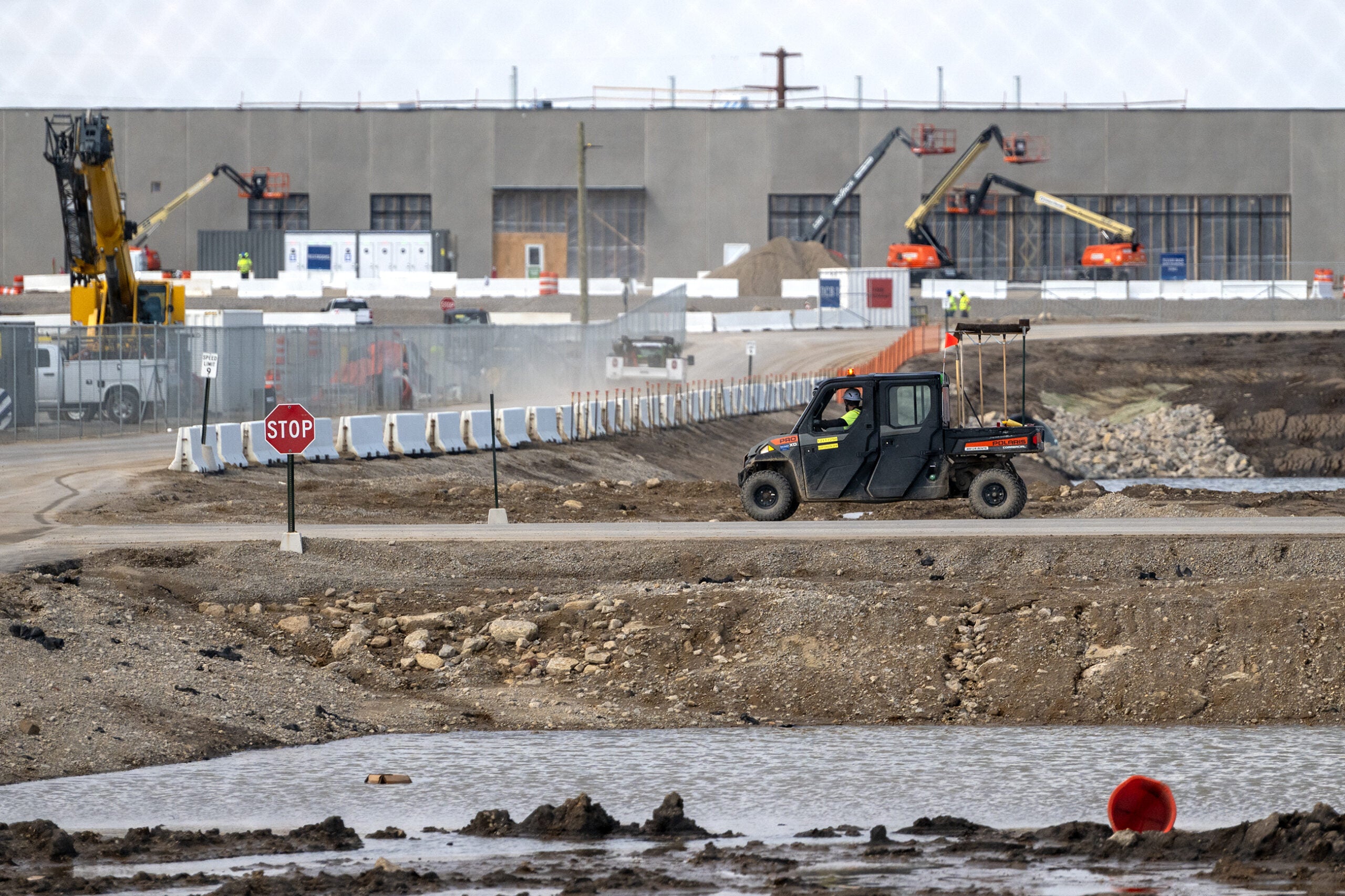
Workers construct a Meta data center Tuesday, April 14, 2026, in Beaver Dam, Wis. Angela Major/WPR
Bob McKee, director of interconnection solutions at ATC, said the company requires minimum transmission charge agreements when transmission construction costs exceed $100 million or when transmission facilities are designed to serve more than 100 megawatts of demand.
“We’ve had other ways to protect customers from costs associated with the transmission capacity requested for a specific large load project, like a data center,” he said. “This is the newest protection. This is just another mechanism that we’ve put in place after gauging, over time, developments in our footprint.”
In a filing with the Federal Energy Regulatory Commission, ATC said the agreement is designed to protect customers as energy needs ramp up for Microsoft’s project in Racine County and if the project ends up using less transmission capacity than planned.
Under the terms of the agreement, the PSC application says ATC will calculate a minimum transmission charge that would require We Energies to pay for the full amount of transmission capacity requested for the project, even if Microsoft ultimately uses less capacity than anticipated.
“It starts charging that utility for this transmission capacity that they requested for their customer when those facilities go in service, not necessarily when they start using it,” McKee said.
According to the application, the payments will be accounted for under We Energies’ special data center rates. That would allow We Energies to “pass through large load costs to its end-use customer or be reimbursed for costs it incurs from its end-use customer,” the application states.
The agreement’s effective date will be set by federal regulators. It would run for 15 years after the final transmission facility needed to serve Microsoft’s project comes online, McKee said.
In a statement, We Energies spokesperson Brendan Conway said the proposed transmission charge agreement builds on the company’s rate structure for data center sized customers, which was approved earlier this year by the PSC.
“We are committed to making sure no costs to serve data centers are shifted to other customers,” he stated. “State regulators unanimously approved that structure, and this filing is another confirmation of that shared commitment.”
Under state rules, the agreement needs approval from the Public Service Commission because it has a potential value of more than $359,000 between affiliated companies, the PSC application states.
We Energies and Wisconsin Public Service, both owned by WEC Energy Group, combine to own more than 50 percent ownership stake of ATC, according to the MacIver Institute, a conservative think tank.
Tom Content, executive director of the Citizens Utility Board of Wisconsin, said the devil is in the details when it comes to whether ATC’s plan will protect residential customers.
“We’re still looking at it, but I think we just want to make sure that it does everything that it purports to do,” he said. “There’s so many moving parts that it’s just important we stay vigilant and monitor this because, with a couple billion dollars (in transmission projects) just for the first few data centers in Wisconsin, that’s a lot of money.”
American Transmission Co., We Energies ask regulators to approve data center cost agreement was originally published by Wisconsin Public Radio.
If you think stories like this are important, become a member of Urban Milwaukee and help support real, independent journalism. Plus you get some cool added benefits.





















One more reason we need a moratorium on Data Centers. The center in Mt Pleasant already has its tax breaks and now it appears we will pay their electrical costs, same with Pt Washington, but a moratorium will save us from subsidizing anymore.