‘Super’ El Niño Coming in 2027, Will Impact Wisconsin
'We will almost definitely shatter the global temperature record in 2027.'
Sunshine. (CC0 Public Domain).
Dan Vimont has a depressing prediction for anyone concerned about climate change.
“We will almost definitely shatter the global temperature record in 2027,” said Vimont, a professor of atmospheric and oceanic sciences at the University of Wisconsin-Madison.
This isn’t just because of the continued warming of the planet, but also because the globe is experiencing an extra strong El Niño warming pattern this year. Some people have taken to calling it a “super” El Niño, although that isn’t a technical term.
“El Niño affects a huge part of our climate system,” Vimont explained on WPR’s “Wisconsin Today.” “The Pacific Ocean has a big impact on global temperatures, so we tend to see the warmest years on record immediately after an El Niño event.”
“So 1998 was the warmest year of the 20th century,” he continued. “2016 was a very warm year that was after the 2015-16 El Niño event, and then most recently the ’23 event. 2024 was a warm year.”
Wisconsin is a long way from the Equatorial Pacific where El Niño originates, but the climate phenomenon affects the state in direct and indirect ways, Vimont said. The most noticeable effect is a likely warmer winter, which can in turn affect the state’s economy, recreation and environmental health.
Vimont and Amanda Latham, a climate outreach specialist with the Wisconsin State Climatology Office, joined “Wisconsin Today” to explain what (super) El Niño is and what it could mean for Wisconsin and the rest of the world.
A warming Pacific
An El Niño happens when the Equatorial Pacific warms by about half a degree Celsius — or 1 degree Fahrenheit — above normal, Vimont said.
“That may seem like not very warm, but that is a massive amount of heat,” he said. “It’s the biggest ocean basin on earth. … And it’s just a complete reorganization of the heat content of the entire tropical Pacific. So, it is the biggest thing that can happen on year-to-year time scales naturally in our climate system.”
The warming water changes the wind patterns and jet streams. A super El Niño is when the ocean warms as much as 2 or 3 degrees Celsius above normal.
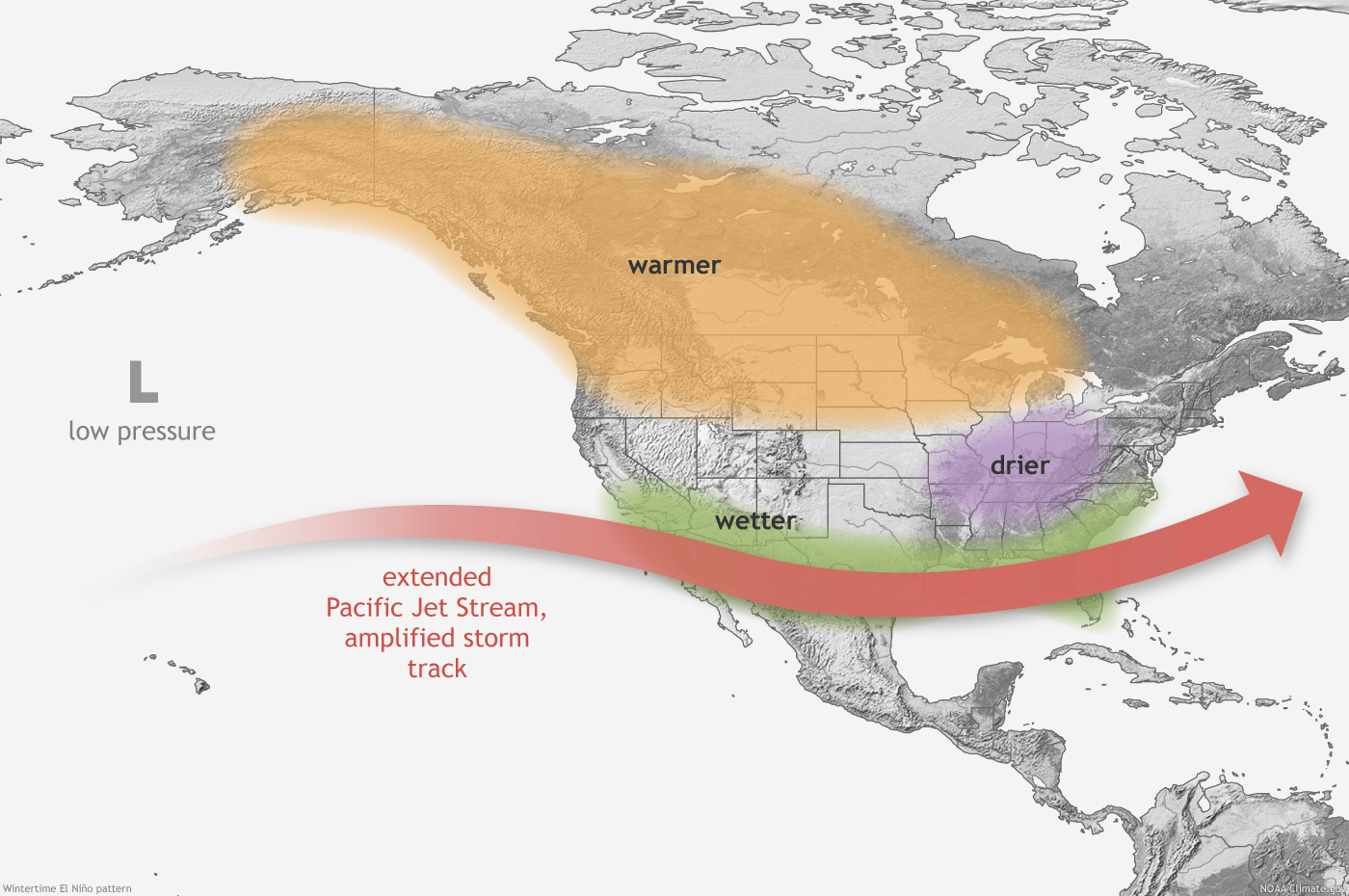
A map of the U.S., Canada, and Central and part of South America showing the affects of El Nino during winter in the Northern Hemisphere. Image credit National Oceanic and Atmospheric Administration
“Typically during El Niño winters, Wisconsin experiences milder temperatures,” Latham said. “That’s one thing that’s been very consistent over decades. There’s no real consistent correlation with precipitation. But if we’re thinking about milder winter temperatures, that can, of course, change the type of precipitation that Wisconsin might see. So possibly, rather than just snowfall from systems, we could see more wintry mixing, more icing, potentially more rainy winter systems coming through with those milder temperatures.”
That’s bad news for businesses that rely on winter tourism and people that love winter recreation.
“I love being outside in winter. I love the snow. I always say I want to be entering our building through the third floor windows, but that hasn’t happened yet,” Vimont said. “And so, when we get these warmer winters, it’s kind of a bummer for me. I want to be out skiing. I want to be out enjoying this great climate that Wisconsin has to offer.”
Global and local impacts
The warmer winters are also harmful for Wisconsin’s many lakes that rely on the annual freezing over to recycle oxygen to the bottom of the lake, Latham said.
“Warm water rises, cold water sinks. And so when we have that cold water on top of the lake, it will sink down to the bottom of the lake through the spring. (It) essentially just refreshes the lake and that’s really important for the health of the ecosystem,” Latham said.
The effects of a warming brought on by El Niño aren’t always obvious, Vimont said, and there can be winners and losers. It might be cheaper to heat your home this winter, but farmers could be facing more pests next season.
The super El Niño could also have serious consequences for other parts of the country and world, causing droughts and wildfires in some places, more intense rainfall and floods in others. It can also cause outbreaks of mosquito-borne illnesses like Dengue Fever and Zika.
“We’re a globally connected society,” Vimont said. “Around here we talk about winter tourism. In Kenya, they talk about, ‘Will we produce enough grain?’ In Indonesia, they saym ‘Will we have to deal with massive food shortages?’”
How effects of a ‘super’ El Niño will feel in Wisconsin was originally published by Wisconsin Public Radio.
If you think stories like this are important, become a member of Urban Milwaukee and help support real, independent journalism. Plus you get some cool added benefits.