
State Democratic Leader Lays Out Policy Plans If Party Wins Trifecta
Senate Minority Leader Dianne Hesselbein points to school funding, property taxes and more.
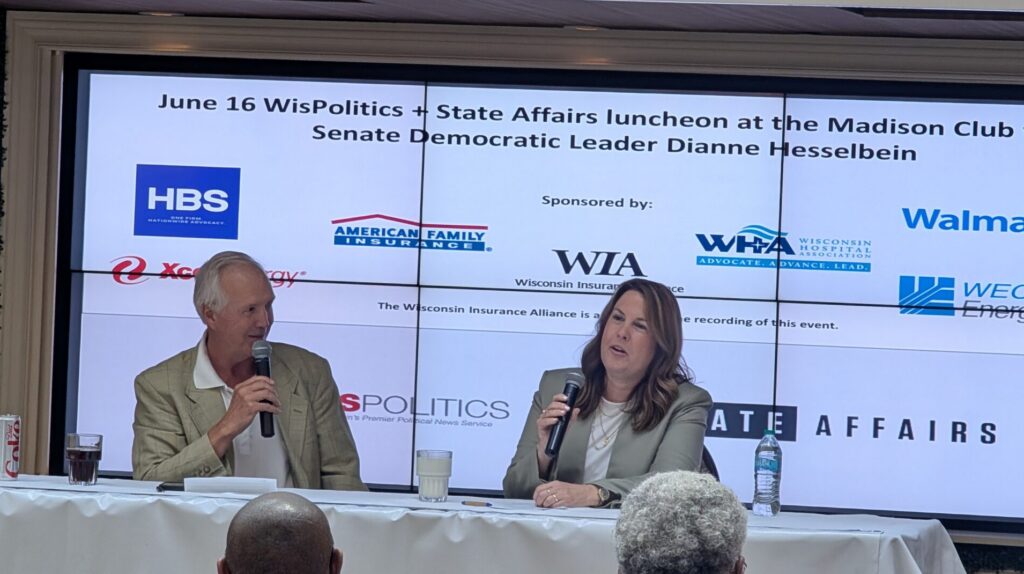
Senate Minority Leader Dianne Hesselbein, who similar to U.S. Rep. Tom Tiffany drank from a glass of milk as she took questions, said Senate Democrats are targeting four seats to flip this year — two more than they need to win a majority. (Photo by Baylor Spears/Wisconsin Examiner)
Senate Minority Leader Dianne Hesselbein (D-Middleton) said legislative Democrats, who are seeking to win majorities for the first time in more than 15 years, are talking about their priorities for the next session including school funding and affordable housing.
Hesselbein said at an event hosted by WisPolitics on Tuesday that Assembly Speaker Robin Vos (R-Rochester), who is retiring, has had a “stranglehold” for a long time and that she hopes new leadership will lead to “new ideas and a real true willingness to work together to get things done for the state of Wisconsin.” Senate Majority Leader Devin LeMahieu (R-Oostburg) is not running for another term in office either.
As they seek a majority, Senate Dems starting policy discussions
Hesselbein said Senate Democrats are targeting four seats to flip this year — two more than they need to win a majority. Republicans currently hold 17 of the 33 Senate seats, and half are up for election this year in newly drawn districts.
The seats include Senate District 5, an open district currently represented by retiring Sen. Rob Hutton (R-Brookfield), Senate District 17, currently represented by incumbent Sen. Howard Marklein (R-Spring Green), Senate District 21, an open district currently represented by Sen. Van Wanggaard (R-Racine), and Senate District 25, an open district currently represented by Sen. Romaine Quinn, who plans to run in a different district this year.
Hesselbein noted that in 2024 people said Senate Democrats were “too ambitious” in targeting five seats even with the new maps, yet they won all five in a year when President Donald Trump carried Wisconsin while Democratic Sen. Tammy Baldwin won a third term.
Hesselbein addressed the public falling-out between legislative Democrats and Democratic Gov. Tony Evers over a tax cut and school funding deal the governor reached with Republicans and most lawmakers refused to support.
Hesselbein said during the event that it was the “overall package” that made Senate Democrats vote against it and there were no political calculations involved. She said it was “unsustainable.”
Democrats will have more say in how the state’s $2.5 billion budget surplus is spent because of the deal’s failure.
Hesselbein confirmed that she was not involved in the negotiation process and it was hard to think about “hypotheticals” that would have made her caucus support the deal. This is not the first time Democratic votes have been needed in the Republican-majority Senate to pass a proposal because a handful of Republicans have opposed legislation.
After the deal failed, Evers said he was sure Hesselbein had “people wrapped around her finger by giving them jobs that they want” next legislative session. The majority leader gets to decide who gets which committee assignments in the Senate.
Sounding the same note as Evers in his unity address at the convention, Hesselbein said that Democrats are moving forward and that there are no hard feelings remaining after her caucus’ rejection of a Evers’ bill. She said her caucus is united in wanting to ensure the financial health of the state.
“Evers has done a good job for the state of Wisconsin,” she said.
“It’s been good,” Hesselbein said of the relationship between lawmakers and Evers.
On whether there could be another attempt to get a tax cut and spending deal passed, Hesselbein said “never say never” and that her “door is always open.” She added that no one has tried to contact her recently about the issue.
Democrats’ top priorities
Hesselbein said some of the big priorities for a Democratic Senate include “funding K-12 education, doing something meaningful for childcare, making sure that no matter where you live in the state of Wisconsin that you can afford a home.” Other issues, she said, are healthcare and the environment.
Hesselbein said it would be a goal in the next state budget to fund schools so they can make financial plans while taking some of the burden off property taxpayers.
“People really care about their community schools,” Hesselbein said. “They are sick and tired of these school boards…having to go to referendum over and over because they want to keep the lights on. We have schools closing all over Wisconsin and that’s a big problem.”
Hesselbein called the funding formula “convoluted” and said that some Senate and Assembly Democrats recently started meeting to look at the state’s funding formula, including looking at how other states structure their funding. She said they want to bring in people from the Department of Public Instruction and Bob Lang of the Legislative Fiscal Bureau to help.
“Is there something else that other states do that makes more sense than what we’re doing and what does that look like?” Hesselbein said she wants to ask.
On specific questions about school funding, Hesselbein was noncommittal.
“It might be something that we can’t get right now… but we’re starting to look at that. We’re starting to think of those things right now to figure out what we can do to make it more sustainable and equitable.”
Hesselbein said declining enrollment is a challenge for schools, but a bigger problem is that the state isn’t adequately funding schools. She said the state “possibly” relies on property taxes too much to fund schools, adding “but how else do you come up with it?”
“That’s the kind of conversations we’re having right now to figure it out,” she said.
Hesselbein also did not commit to offering free school meals as the state of Minnesota has done.
“It’s pretty darn expensive. We’re not sure if we’re going to be able to get all the way there,” she said, adding that the caucus is trying to figure out “what do we want to get done and how do we get there.”
Tackling the cost of living, land conservation
Hesselbein said Democrats are beginning conversations with developers and realtors about how to ensure that people can work and afford a home in Wisconsin.
“We’re just now starting those conversations now to figure out what we can do,” she said.
The Knowles-Nelson Conservation program is on track to sunset in June. Hesselbein said she is disappointed that Republicans and Democrats could not agree on a bill to reauthorize the program. She said there was only a “30-second” conversation about the popular land conservation program during the negotiations on the rejected tax rebate and school funding package.
“We absolutely need it. Knowles-Nelson has been around for so long and it’s worked so well making sure we have green spaces in the state of Wisconsin to enjoy,” Hesselbein said. “If Democrats are in charge and we have a Democratic trifecta, Knowles-Nelson will be back.”
Undecided on gov primary
Wisconsin will also have a new governor next year, who will help shape the state alongside new legislative leaders.
The seven Democrats who will appear on the August primary ballots include Milwaukee County Executive David Crowley, state Rep. Francesca Hong (D-Madison), Lt. Gov. Sara Rodriguez, state Sen. Kelda Roys, former Wisconsin Economic Development Corp. CEO Missy Hughes, former head of Gov. Tony Evers’ Department of Administration Joel Brennan and former Lt. Gov. Mandela Barnes.
Hesselbein said it is “exciting” there are so many choices.
She added that she, like other Democrats, hasn’t made up her mind about who she will vote for in August. She said she also does not know whether she’ll endorse anyone in the primary for governor, noting that she has served with several of the candidates in the Legislature including Roys, Hong, Rodriguez, Crowley and Barnes. She also said she wants to hear them debate. A candidate debate is scheduled for July 28, hosted by WISN-12.
“They’re all really good people,” Hesselbein said.
U.S. Rep. Tom Tiffany is running on the Republican side with the endorsement of President Donald Trump and the state party.
Hesselbein said having a competitive primary is a good thing, noting that Evers won a crowded primary in 2018 and went on to win two terms in office.
“I think it really lets the people of Wisconsin decide who they want to be supporting in the November election,” Hesselbein said. “I think it’s too bad that the Republicans put their thumb on the scale and Trump did in endorsing Tiffany early, I think it would’ve been better for them to have a robust primary as well.”
Senate Minority Leader Dianne Hesselbein lays out policy plans for a Democratic trifecta was originally published by Wisconsin Examiner.
Political Contributions Tracker
Displaying political contributions between people mentioned in this story. Learn more.