Present Music Celebrates Hindu Festival
Audience members can get in the spirit and wear festive Indian attire.
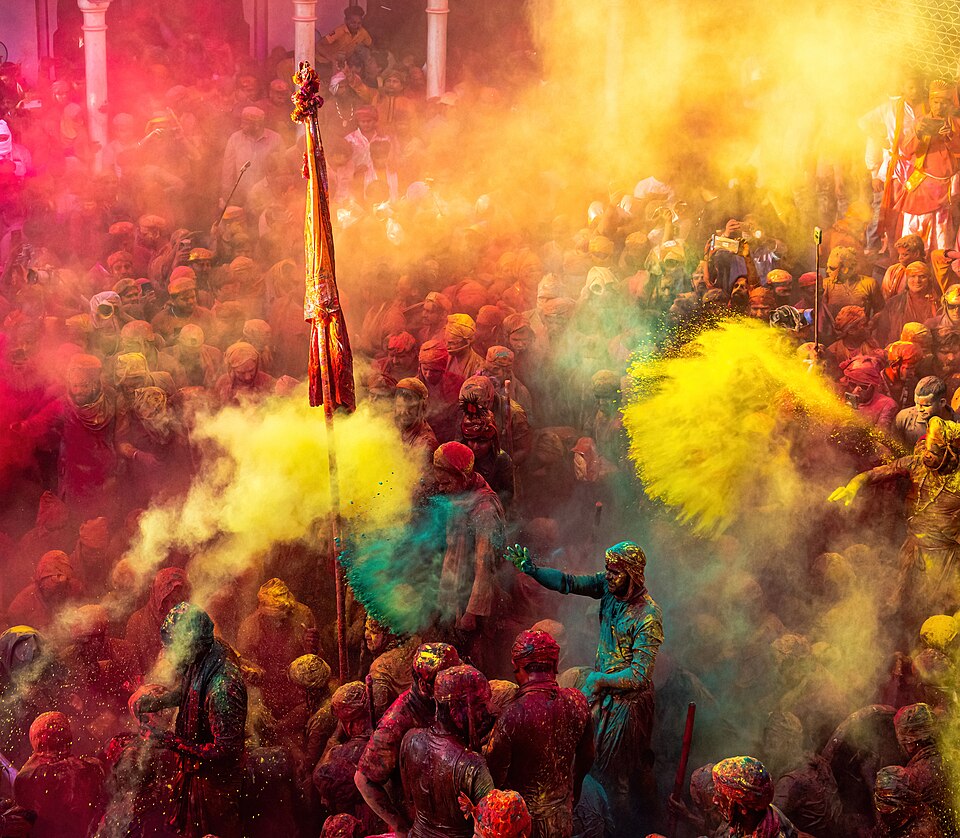
Celebrants throwing powdered paint at India’s Holi Festival. Photo by Original: Sachinghai09Derivative work: Radomianin, (CC BY-SA 4.0), via Wikimedia Commons.
On March 20 and 21 at the Jan Serr Studio, Present Music will explore religious celebration, cinema, and contemporary music through a screening of Radhe Radhe: Rites of Holi. The film offers an immersive look at the observance of the Hindu Holi festival in the Braj (also spelled Vraja) region of northern India.
The mythical home of Krishna, the sacred region of Braj celebrates for more than a week leading up to Holi. The region transforms into a riot of color, music and devotion — considered by many to be the most immersive and spiritually rich Holi celebration in the world.
As part of a 2013 collaboration marking the 100th anniversary of Stravinsky’s Rite of Spring, filmmaker Prashant Bhargava and composer Vijay Iyer produced a film inspired by the sweep and energy of that landmark ballet. Where Stravinsky imagined a pagan Russian village festival marked by dancing, blessings, and the ritual sacrifice of a maiden, the Hindu festival of Holi offers a more joyful response to spring, rooted in the stories of Krishna and his lover, Radhe.
Bhargava notes that although Holi is celebrated across India, in the Braj region it unfolds over eight days “in a way that was primal, violent, sexual and celebratory — a complete release of inhibition. It was a true emergence of springtime in such a beautiful way.”
Bhargava edited his film to fit the timing and emotional arc of Stravinsky’s masterpiece, then forwarded it to Iyer to compose an original score. Iyer’s music inherits Stravinsky’s broad emotional sweep while remaining immersed in the Indian celebration, drawing energy and rhythm from the festival scenes without directly incorporating the celebrants’ music. At the peak of the raucous festivities, he lets the noise of the crowd and the drive of a drum set carry the moment.
Preview a recorded version of this concert film within a larger event online.
Three short works open the program:
Christopher Cerrone‘s Hoyt-Schermerhorn (2021) was written during the COVID pandemic, reflecting Cerrone’s experience of that time. He named it “after a subway station in Brooklyn where I have spent many a night waiting for the train.”
The challenge was to write an atmospheric work for prepared piano that sounds like improvisation. The “almost aimless texture” is carefully composed. “This section slowly transforms into the second half of the piece, a (mostly) soft and gentle lullaby, coated with a shatter of fragmented electronics breaking the quiet haze.”
The Milwaukee performance has been adapted for two pianos. Present Music artistic director Eric Segnitz suggests the addition will expand the experience. “I think the idea behind the piece was to illustrate contradictory feelings. So you’re hearing contradictory feelings at the same time. He’s talking about nostalgia, anxiety, joy, panic — meditating on the New York skyline from the context of this lonely subway station.”
Jlin Patton‘s Little Black Book (2021) began as an electronic dance piece written for footwork, a Chicago-style dance. The Kronos Quartet transcribed the work for string quartet and bass kick drum, with strings mimicking the dance beats.
Judd Greenstein‘s Jitter Pocket (2024) explores disco-inspired dance music, drawing on the genre’s variety of pulses and rhythms while injecting instability into an otherwise predictable form. Performed on amplified classical instruments and drum kit, Greenstein writes, “Jitter Pocket became a short study in what the name implies: a jittery pocket, an unsettled groove that eventually finds its footing.”
Fifteen musicians will perform, including guest pianist Isabelle O’Connell, percussionist Doug Perkins and contrabassonist Susan Nelson. David Bloom, Present Music artistic advisor and conductor, will lead the ensemble.
Present Music encourages participants to dress in festive Indian attire and will offer Indian food, drinks and face painting to mark the occasion — though the venue’s lease, I am told, will not permit throwing paint over the audience.
The program starts at 7:30 p.m. Friday and Saturday, March 20 and 21. The Jan Serr Studio is located on the top floor of the UW-Milwaukee Peck School of the Arts Kenilworth building at 2155 N. Prospect Ave., south of campus. Tickets may be purchased online or at the door. At 6:45 p.m., Dr. Prasenjit Guptasarma from UW-Milwaukee will offer a pre-talk about the Holi festival.
Present Music’s last concert of the season features composer/flutist/vocalist Nathalie Joachim, who will perform her piece Ki Moun Ou Ye, which explores her Haitian heritage. The performance will be held at the Milwaukee Art Museum.
If you think stories like this are important, become a member of Urban Milwaukee and help support real, independent journalism. Plus you get some cool added benefits.


Preview
-
Frankly Music Showcases Virtuoso Players
 Mar 10th, 2026 by Michael Barndt
-
Six Centuries of Secular Song
 Mar 3rd, 2026 by Michael Barndt
-
Prometheus Trio Performs Music By Milwaukee Native Daron Hagen
 Feb 11th, 2026 by Michael Barndt