
3 Data Centers Driving 40% Hike in Projected Wisconsin Peak Electricity
Report finds 70% of growth in peak demand will come from 3 centers in southern Wisconsin.
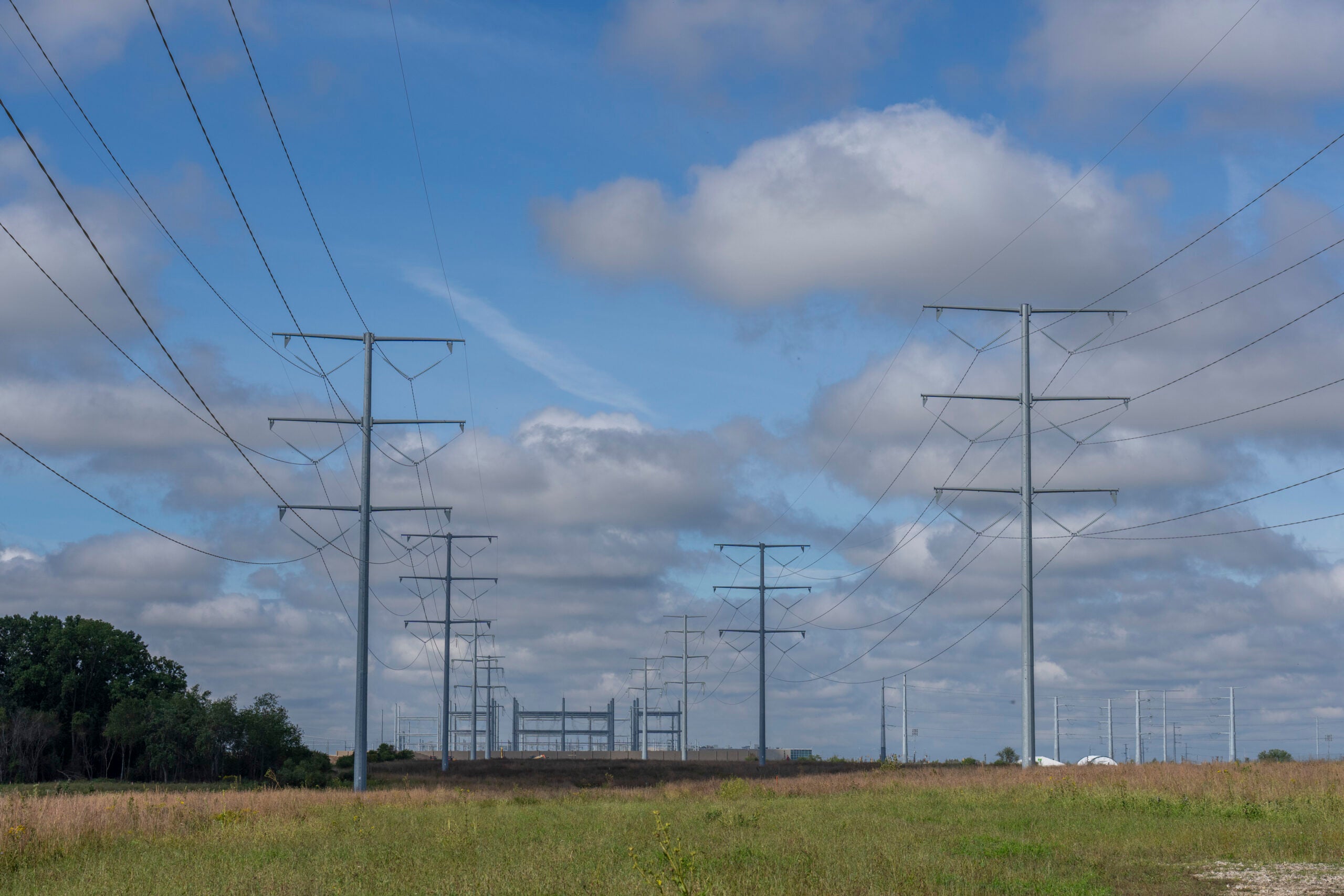
High-capacity power lines serve Microsoft Corp.’s Fairwater data center in Mount Pleasant, Wis., on Sept. 24, 2026. Andy Manis for Wisconsin Watch
Wisconsin’s peak electricity demand is expected to grow by more than 40 percent by 2032, driven by data centers. That’s according to a newly finalized report by state regulators.
Environmental groups worry the rush to meet that growth will derail the state’s climate goals.
The Public Service Commission of Wisconsin on Thursday approved the state’s strategic energy assessment for 2026 through 2032, showing more than 70 percent of the growth in peak demand is tied to data center projects in Mount Pleasant, Port Washington and Beaver Dam.
The assessment provides a snapshot of current and future electricity supply, including the types of generation utilities are planning and their projected carbon emissions.
Summer Strand, chair of the Public Service Commission, said the projected rise in peak demand is unprecedented after years of relatively stagnant growth.
“Prior to the data center, or hyperscaler, situation taking off in Wisconsin, there was electrification and some energy transition things happening, and that was maybe creating a little more demand,” she said. “But nothing like 40 percent — 40 percent is a massive number.”
Strand also raised concerns that regulators may not have enough tools under state law to plan for that spike while protecting the environment and ratepayers.
And while the state has set a goal of reaching 100 percent carbon-free electricity generation by 2050, there’s no legal mechanism requiring utilities to meet that goal.
Wisconsin utilities are planning to meet surging demand by adding 14.4 gigawatts, or GW, of electricity generation to the grid, the report shows. The biggest chunks of that come from solar and natural gas, which account for 5.8 GW and 5.2 GW, respectively. The rest is split between wind and battery storage.
Utilities have said natural gas projects are needed because the North American Reliability Corporation, a nonprofit that monitors risks to the electric grid, warns the Midwest faces an “elevated risk” for electricity shortages beginning in 2028.
Concerns about powering the data center boom aren’t exclusive to Wisconsin.
New research from Harvard shows that more than half of the electricity powering hyperscale data centers nationally comes from fossil fuels, like gas and coal. The study also found U.S. data centers consume as much electricity annually as some states.
The report found that 403 hyperscale data centers accounted for 1.8 percent of total U.S. electricity consumption, and were associated with about 25.7 million metric tons of CO2 emissions.
“We shouldn’t be solving tomorrow’s technological challenges by creating decades of environmental problems,” said Gianluca Guidi. “How we power this expansion really matters just as much how fast we build it.”
Guidi told WPR that the report’s findings are already outdated.
“The study and the numbers that we provided are already a year and a half old, which is basically ancient history in the AI world,” he said. “We have preliminary studies showing that the number of hyperscalers have almost actually more than doubled.”
Guidi called a 40 percent increase in peak electricity demand in Wisconsin “terrifying.”
He also said the energy infrastructure supporting data centers across the country is being built “faster than we can independently measure its consequences.”
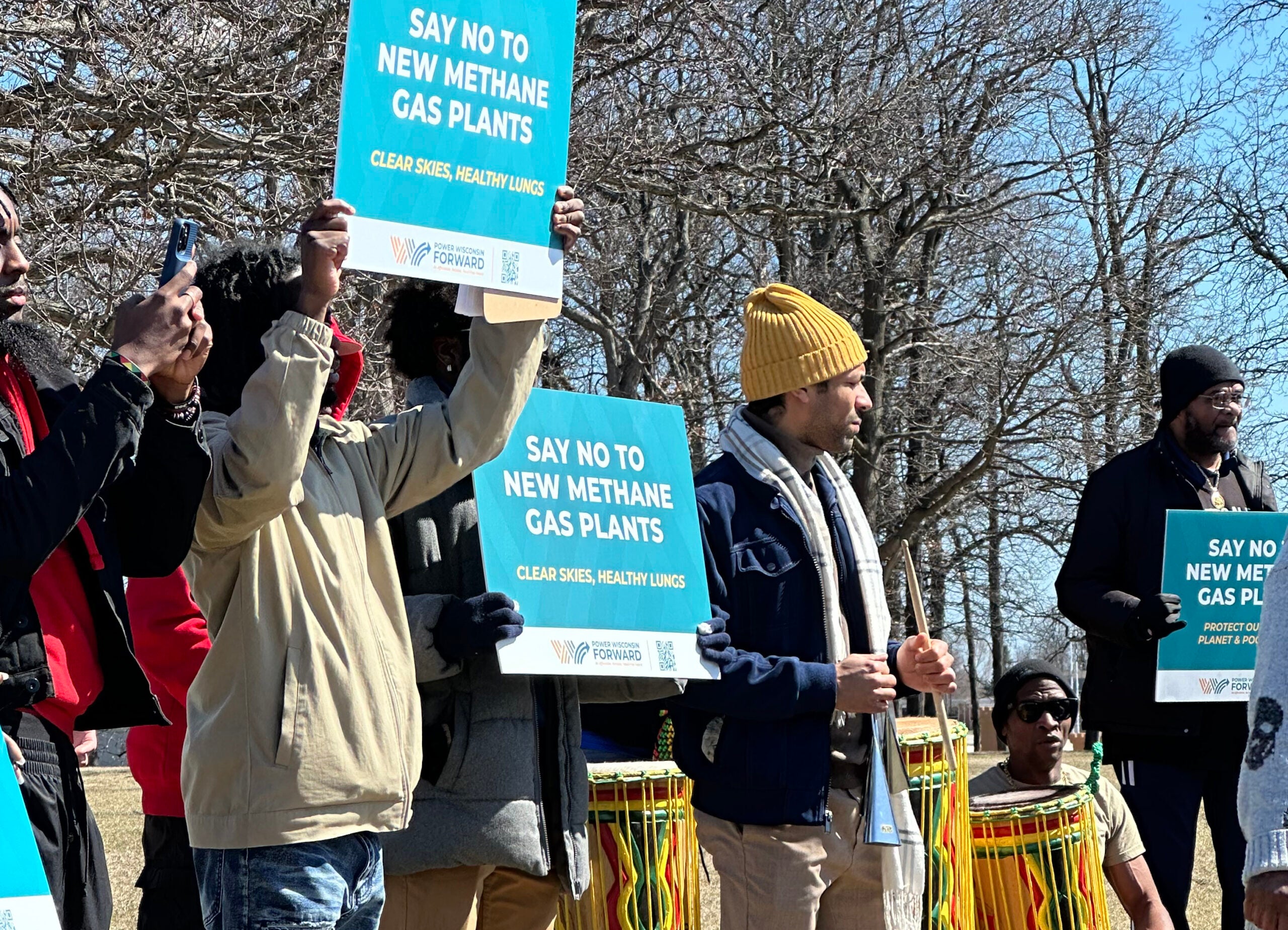
People hold signs calling on the Public Service Commission to deny the approval of a new natural gas plant in Oak Creek ahead of a public hearing on the project Tuesday, March 25, 2025. Photo courtesy of Sierra Club Wisconsin
Environmental groups warn new gas plants risk climate progress
Environmental groups say building new fossil fuel plants to meet data center demand could undermine efforts to reduce carbon emissions.
A new report from the Sierra Club argues the rush to build natural gas plants across the country could erase pollution reductions over the last 15 years that have come primarily from retiring coal-fired power plants.
By 2030, the report warns the United States’ electric sector could emit more carbon dioxide —2,317 million tons — than it has since 2011.
With Wisconsin utilities planning more than 5 GW of natural gas generation in the coming years, Cassie Steiner, campaign coordinator for the Sierra Club’s Wisconsin Chapter, said the trends in the national report are being “echoed in Wisconsin.”
“Even if the data centers pay for the infrastructure and the fuel, we all will be paying for this in the severe climate impacts and the health impacts that are going to come from all of this new fossil fuel generation,” Steiner said.
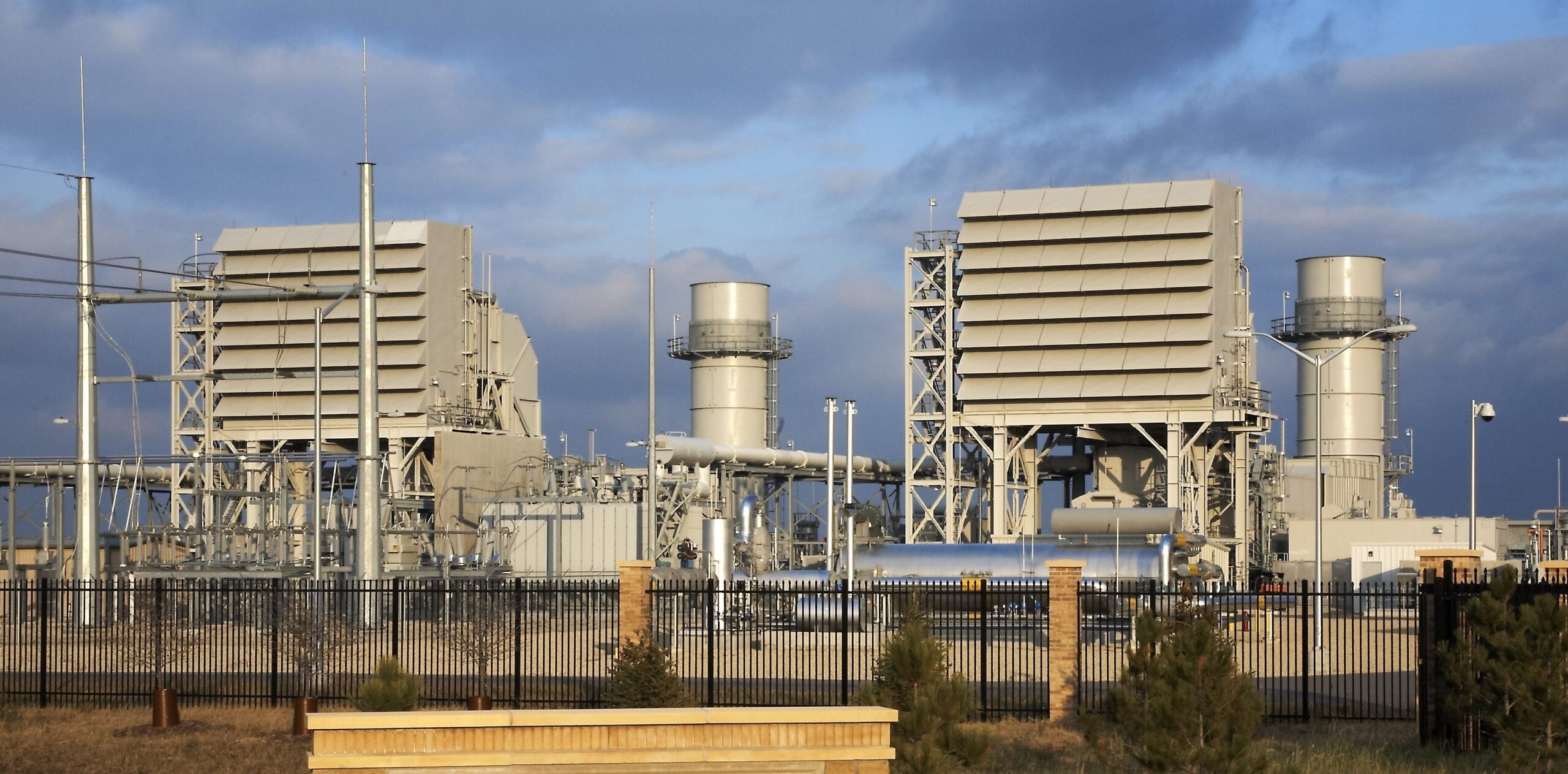
A simple cycle natural gas power plant is seen in Minnesota. Photo courtesy of Invenergy
Utilities plan ‘all of the above’ approach to energy generation
Wisconsin utilities are planning to invest in a mix of natural gas and renewable energy in the coming years, the PSC’s draft report shows.
Anna Haensch, an associate research professor in UW-Madison’s Data Science Institute, said utilities spent the early part of the decade investing in renewable energy and promoting their climate goals, before turning back to fossil fuel projects as demand projections surged.
“The reason we are getting so much natural gas right now is because we need what’s called ‘firm power,’” she said. “Data centers need power that’s going to show up 24/7, around the clock, super reliable in rain, sleet or snow. And that’s fossil fuels.”
The state’s largest utility, We Energies, plans to add nearly 4.6 GW of natural gas capacity in the coming years, as well as 4.1 GW of solar, the PSC report showed. Wind and energy storage combined for nearly 1.9 GW.
Both the Port Washington and Mount Pleasant data center campuses are located in We Energies’ service territory.
The utility’s parent company did not report its expected CO2 emissions for 2032. In a regulatory filing, the company said that information was not available.
We Energies has paused its near-term carbon emissions reduction goals, but maintains it remains committed to achieving net carbon-neutral electric generation by 2050.
“Our ‘all of the above’ plan includes major investments in solar, wind and battery storage, supported by state-of-the-art natural gas generation that can operate when the sun is not shining or the wind is not blowing,” We Energies spokesperson Brendan Conway said in a statement. “This approach allows us to retire older, less-efficient fossil-fueled generation while keeping customers’ lights on all year-round.”
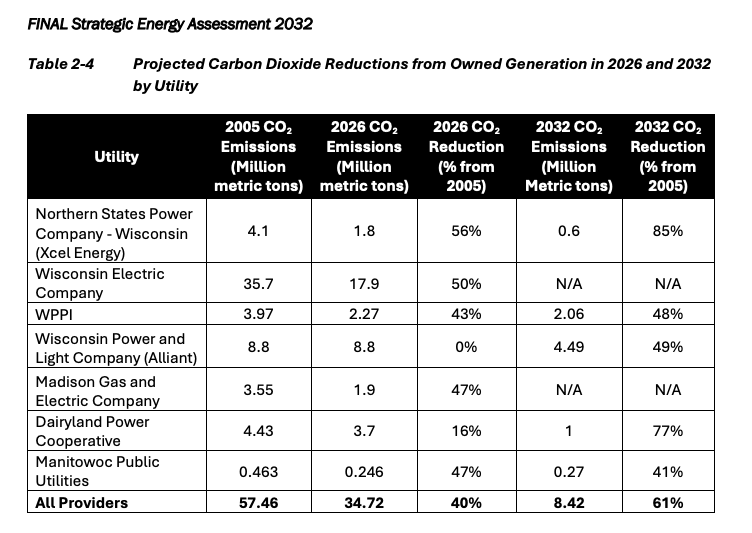
This table shows Wisconsin electric utilities’ forecasted carbon dioxide emissions. Wisconsin Electric Company, the parent of We Energies and Wisconsin Public Service, declined to submit its projected carbon emissions for 2032. Two massive data center projects are located in We Energies’ service territory and the utility plans to add more than 4 gigawatts of natural gas capacity. Source: Public Service Commission of Wisconsin
Alliant Energy, the utility that will serve the data center being built in Beaver Dam, plans to add 356 megawatts of upgraded natural gas capacity at three existing sites by 2032, the PSC report shows. The company also plans to add 790 MW of renewable energy.
The company expects its CO2 emissions in 2032 will be down 49 percent from 2009 levels, according to the PSC report.
In a statement, a spokesperson for Alliant Energy said the company remains committed to its goal of achieving net zero carbon emissions by 2050.
“While our journey may require the use of several different types of generation resources for the time being, we are also participating in research activities to find lesser carbon emitting generating fuels and technologies,” the statement read.
But in order for utilities to actually hit their long-term climate targets, Haenesch said they need to retire old fossil fuel plants and bring “tons and tons of new renewable energy” online.
“Wisconsin is looking to almost double its wind and solar capacity by 2032, which is fantastic,” she said. “But then at the same time (utilities are) not retiring fossil fuel plants, and they’re actually bringing new ones online.”
“It’s not enough to just stop making a mess in your room,” she added. “You have to clean it up as well.”

Flanked by Gov. Tony Evers, Public Service Commission chair Summer Strand speaks at an event at the Wisconsin State Capitol in Madison, Wis. Angela Major/WPR
PSC chair renews call for Legislature to give agency more planning authority
Strand, the PSC chair, said she’s concerned that regulators may not have enough tools to adequately plan for the spike in energy demand.
Under current state law, she said the commission approves generation projects on a case-by-case basis as utilities or developers file applications to build them. She said the primary planning tool the commission has is its strategic energy assessment, or SEA.
“The SEA has no teeth. It’s more of a report,” she said. “We’re not really opining or editorializing, and we’re definitely not saying yea or nay on a comprehensive plan. We’re gathering data and information, analyzing that and then publishing information.”
Instead of an SEA, she said many states use a process known as integrated resource planning to review and analyze utilities’ capital plans, and exercise authority over planned generation additions or retirements.
Strand said integrated resource planning, or a similar process, would allow regulators to respond to the challenges spiking energy demand creates, such as pressure on energy bills and climate concerns.
“If ever there was going to be a time to help kind of restore the commission’s proper oversight role in generation and resource planning, now is the time,” Strand said.
Report: 3 Wisconsin data centers account for 70 percent of growth in peak electricity demand was originally published by Wisconsin Public Radio.
If you think stories like this are important, become a member of Urban Milwaukee and help support real, independent journalism. Plus you get some cool added benefits.