
Journal Sentinel Hasn’t Answered Questions in Barnes Controversy
Role of ‘conflicted reporter’ is a major, embarrassing issue for the newspaper.
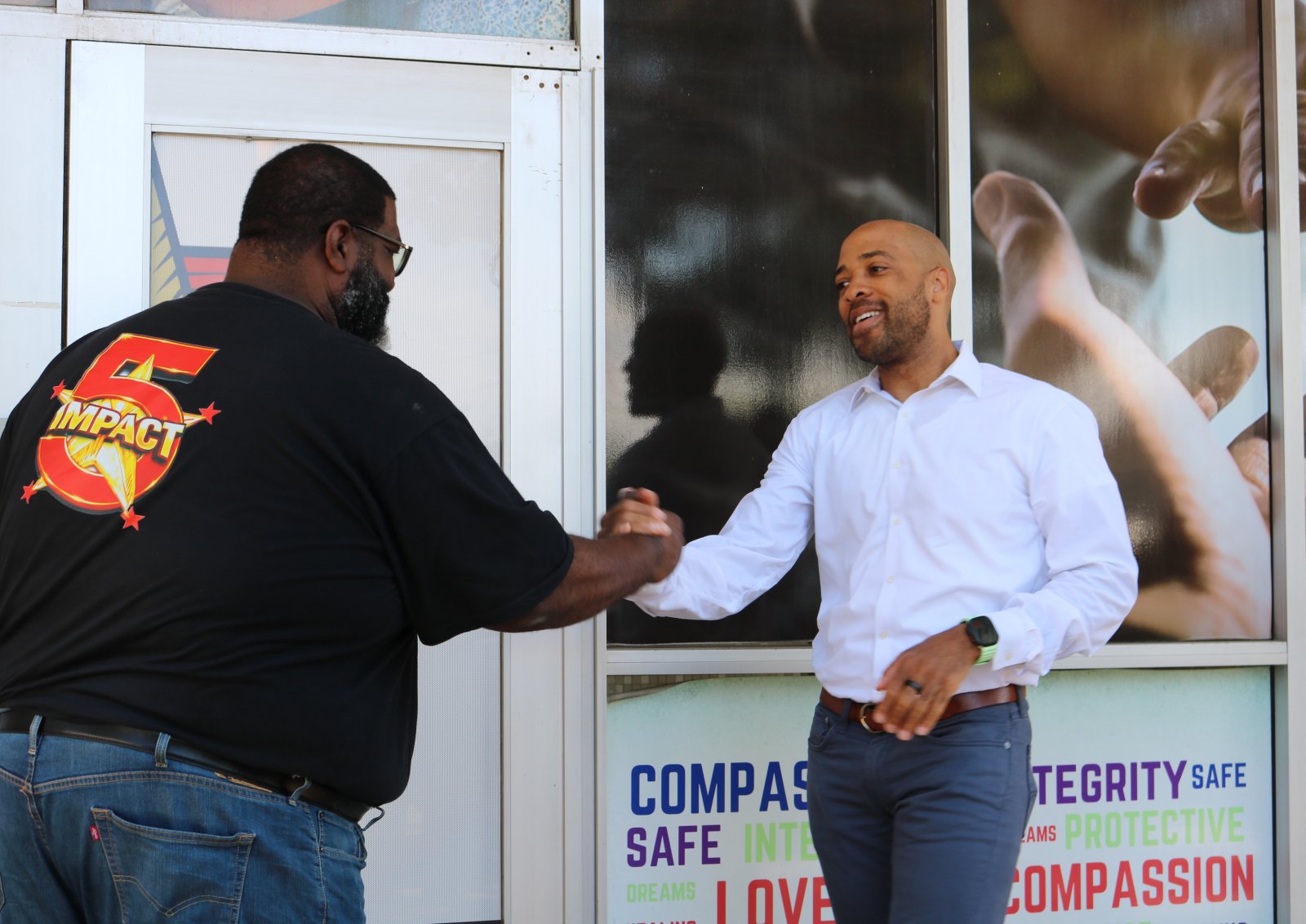
Mandela Barnes (right) greets Jacob Gatlin, community liaison for Five Star Impact, during a campaign stop. Photo taken June 16, 2026 by Sophie Bolich.
On November 10 we learned that former lieutenant governor and Democratic candidate for governor Mandela Barnes was suing the Milwaukee Journal Sentinel for defamation, and claimed that a female reporter at the newspaper had a past sexual relationship with him yet was involved in reporting a story on his sex life.
By 6:30 that evening at least 14 media outlets had covered the controversy, including a story by Urban Milwaukee. The feeding frenzy has continued, with the New York Post the most recent of several more media outlets to chomp on the juicy tale of the “conflicted reporter.”
It is remarkable how many bad decisions the Milwaukee Journal Sentinel made in its reporting on Barnes, and how many unanswered questions that has left.
The newspaper’s first mistake, in a July 30 story reporting that Barnes was withdrawing from the Democratic race, was to put this in the second paragraph: “The decision by Barnes came amid reporting by the Milwaukee Journal Sentinel into allegations that Barnes was taking advantage of his role in the party to have sexual encounters with young adult women.”
This vague yet damning description tipped off alert readers that the newspaper didn’t really have much of a story. Yet it forced the paper to publish the follow-up story so it wasn’t dangling this charge against Barnes without proving it.
Why did the editors put themselves in this difficult position? By withdrawing from the race, Barnes made the story far less important. Whatever his reasons for quitting (Barnes says it was because of other financial and political reasons), he was now back to a mere citizen with no campaign or political position so why should readers care about his sex life? The JS should have killed the story without a mention of it to readers.
We’ll never know the discussion that went on in the newsroom, but we do know one of the three reporters who worked on the story about Barnes’ sex life had herself had an affair with him. So says Barnes, and the Journal Sentinel has not denied this. Was she part of the discussion as to whether the story should run?
The suit by Barnes says his campaign disclosed the relationship he had with this journalist and that the newspaper “acknowledged the conflict and removed the reporter, and other reporters were to re-report portions of her work.”
The Journal Sentinel, in its story about the suit, essentially admitted the point, saying “That reporter was not involved in reporting or writing the published story, Borowski said.”
One might ask why a story that offered a quote from its executive editor Greg Borowski saying the JS “stands by our reporting” then offers not a direct quote, but a summary of Borowski’s comment on the conflicted reporter. More important, his reference to the “published story” leaves open the possibility that the conflicted reporter was involved in early drafts of the reporting.
And how much did those drafts change? Barnes’ suit notes the paper published this story later on the same day it learned of the conflict. “Removing the reporter from the assignment did not resolve the questions created by her participation,” the suit notes. “The Journal Sentinel still needed to determine how the story had originated and developed, what information the reporter had gathered, which sources and leads she had pursued, what assumptions had influenced the reporting, and whether the acknowledged conflict had affected the story’s premise, sourcing or framing. The Journal Sentinel did not postpone publication to resolve those questions.”
And if this reporter was conflicted and ultimately removed from this story because of her relationship with Barnes, how far back does that conflict go? Barnes’ complaint calls her a political reporter, which suggests she could have done coverage of the Democratic campaign for governor. Did she work on stories about Barnes, whose campaign lasted eight months and was considered one of the leading candidates? Will the Journal Sentinel disclose this to its readers?
Should this case go to a jury trial, one could imagine Barnes’ attorney, Michael J. Cerjak, seeking to put the reporter on the stand and question her. That could be embarrassing. Nor is that the only potentially damaging information that could surface.
The JS story leads with an unnamed person’s claim that the Wisconsin Democratic Party “hired an outside law firm” and “launched a probe” after receiving an anonymous letter with allegations against Barnes. Who was this unnamed person? Was it the same person who wrote the anonymous letter? The story doesn’t say.
But Barnes’ complaint says the story is false: “The Democratic Party did not specially retain an outside law firm to investigate Mr. Barnes. The party’s regularly retained counsel may have reviewed the anonymous letter in its ordinary advisory capacity, but neither counsel nor the party conducted a factual investigation or ‘outside probe.’ No witnesses were interviewed, Mr. Barnes and his campaign were never contacted or interviewed, no specific incidents were investigated, and no investigative report, findings, or determination concerning Mr. Barnes were produced.”
And though the newspaper teased an exposé on Barnes’ “sexual encounters,” the story has only one interview with a woman who had sex with Barnes. This was after a party and “heavy night of drinking,’ and she “could not have been of sound mind for an enthusiastic yes,” the woman said. But she was enthusiastic enough to continue having sexual encounters with Barnes after this, by her own account.
Barnes’ complaint says “The Journal Sentinel was provided with contemporaneous communications bearing directly on the nature and continuation of the relationship.” If so, none of it made it into the story; “the article did not fairly present that context,” the complaint says.
The Journal Sentinel has 45 days to respond to the complaint. Odds are they will file a motion to dismiss the case and hope they get lucky. If the case goes to a trial and the newspaper has to explain how and why the story was reported, it will be another feeding frenzy for the media.
If you think stories like this are important, become a member of Urban Milwaukee and help support real, independent journalism. Plus you get some cool added benefits.


Murphy's Law
-
17 Democratic Policy Changes Voters Will Support
 Nov 17th, 2026 by Bruce Murphy
-
How Democratic Legislators Could Fund Sweeping Changes
 Nov 11th, 2026 by Bruce Murphy
-
Is Wisconsin Now a Blue State?
 Nov 9th, 2026 by Bruce Murphy