
Wisconsin’s For-Profit Electric Utilities Hike Rates More Than Public Utilities
Rate hikes twice as high for investor owned utilities since 2020.
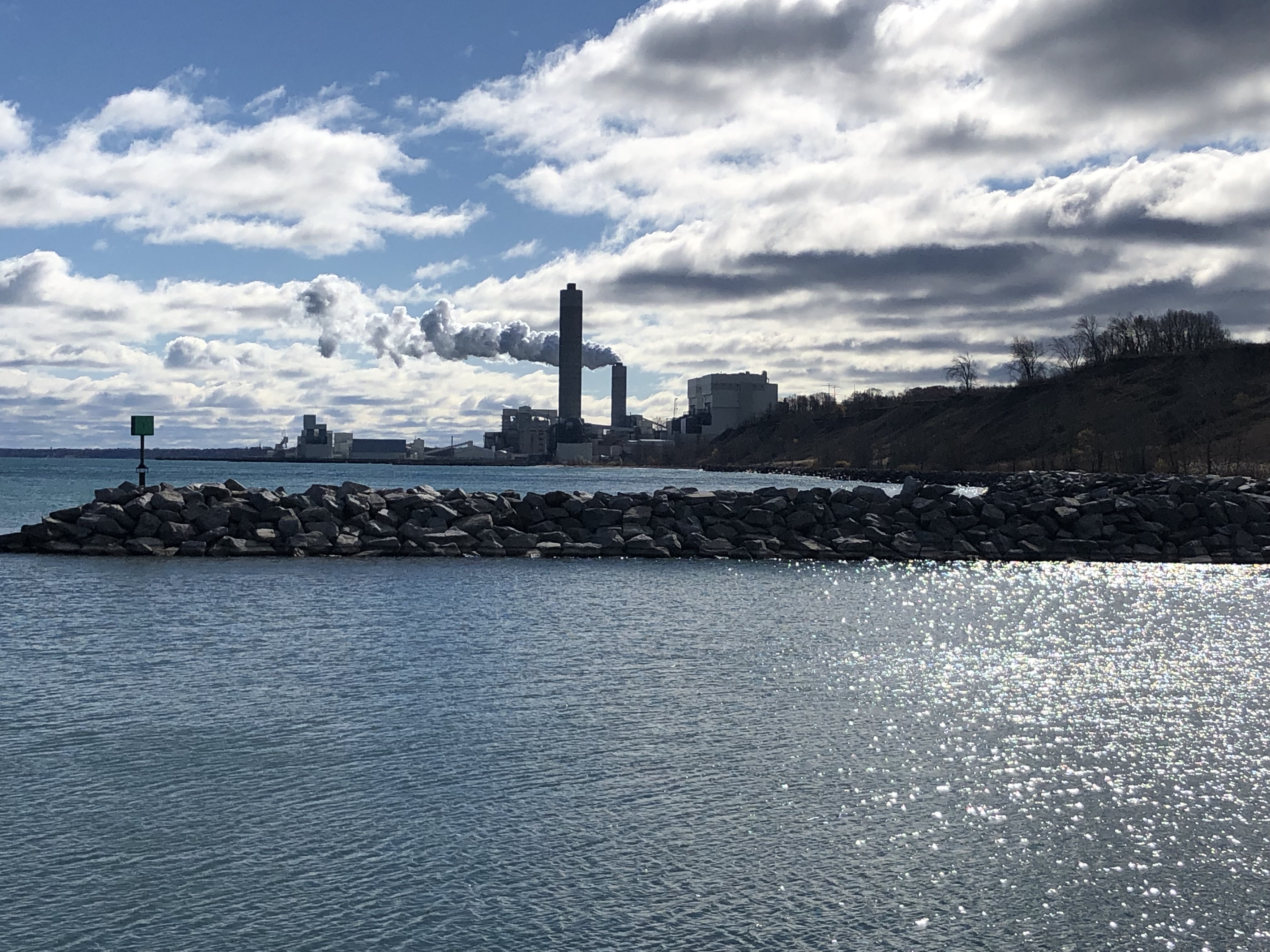
Oak Creek Power Plant. Photo taken November 13, 2021 by Dave Reid.
Last week, the Wisconsin state utility regulator approved two more years of rate hikes for two of the state’s largest for-profit electric utilities. These hikes continue a trend of large increases dating back to 2020.
No doubt the cost factors that go into rising rates are varied and complex, but Wisconsin’s mix of electricity providers offers a simple way to compare electricity costs. The state is covered by three different kinds of electric utilities. A few large investor-owned companies cover most of the state’s population, but dozens of cities operate their own municipally owned electric utilities, and more than two dozen member-owned cooperatives provide service to rural areas where for-profit investment was originally seen as unviable.
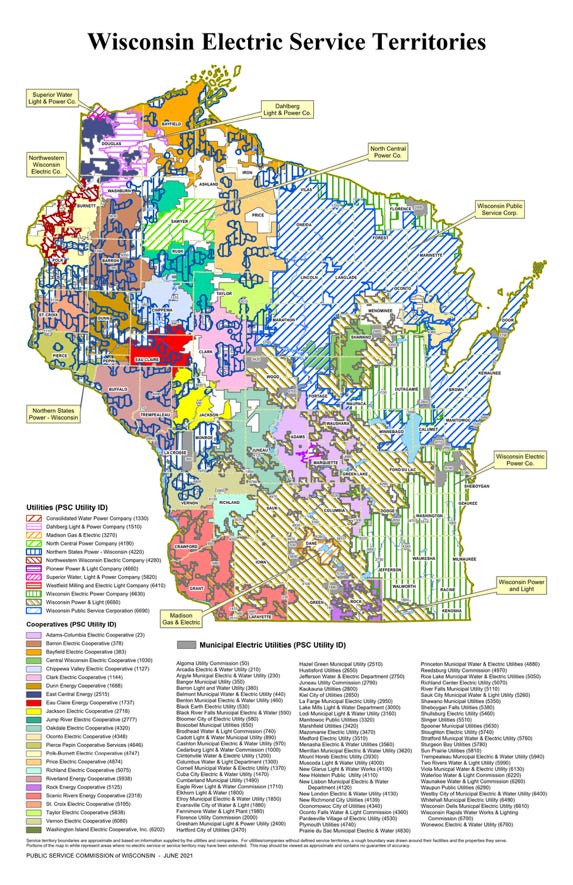
Map of Wisconsin electric service territories (click for full-size image)
Costs like labor inflation, commodity prices and grid maintenance presumably affect all utilities more or less equally, and every kind of utility has raised rates since 2020. However, the investor-owned utilities have raised their rates by about twice as much as the municipally and cooperatively owned utilities.
The U.S. Energy Information Administration (EIA) collects annual statistics from utilities across the country. For each reporting utility, the EIA-861 form includes the number of residential customers, the megawatt-hours they consumed, and the revenue collected from them. With these numbers, we can calculate the cost per kilowatt-hour (kWh) charged to residential customers by each utility.
Some small utilities aren’t required to supply EIA-861 data each year, so I’ve limited the following analysis to the 65 utilities that reported data in every year from 2001 through 2025. In 2025, this covers 2.69 million residential customers. In total, 86.6% of these residential customers bought power from an investor-owned company, 8.1% from a municipal utility and 5.3% from a cooperative. Since I’m not including the smallest municipal and cooperative utilities in this analysis, the real statewide market share for these types of utilities is closer to 19%.[i]
For each class of ownership, I calculated the aggregate rate: total revenue divided by total electricity sold.
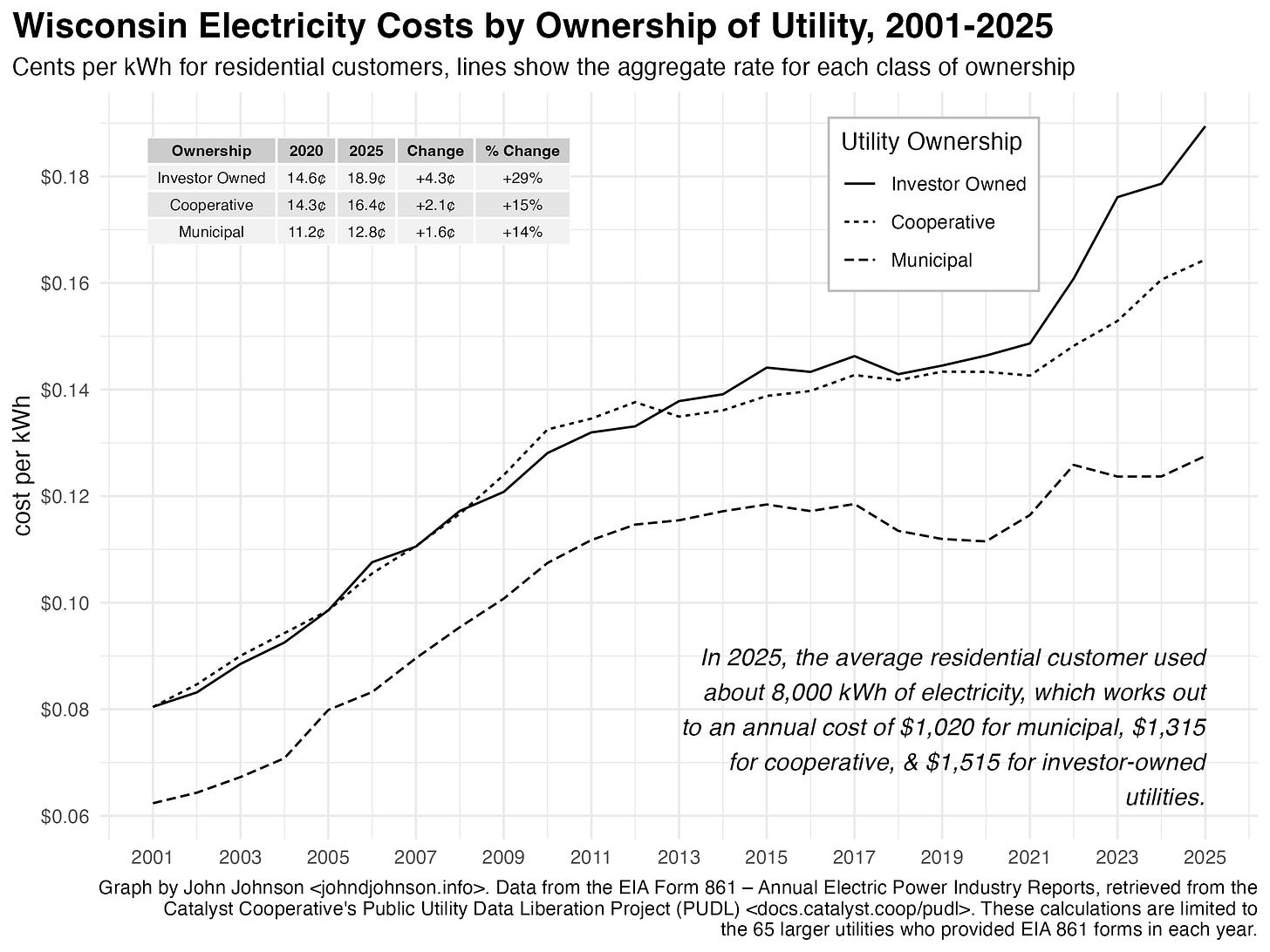
Residential cost per kWh by utility ownership, 2001-2025
Municipal utilities have always charged much less than cooperatives or investor-owned utilities. This reflects, I assume, the small geographic area they serve. A utility covering a single city can spread the cost of each distribution mile across more customers. Cooperatives, on the other hand, were established specifically in rural places with higher costs per customer.
Until 2020, Wisconsin’s investor-owned utilities closely matched the cost of cooperatives, but they’ve since diverged. Now, investor-owned utilities charge substantially more.
Since 2020, the cost per kWh has grown by 29% for investor-owned utilities, 15% for cooperatives and 14% for municipally owned utilities. As of 2025, the cost per kWh charged by investor-owned utilities was 115% of the cost of cooperatives and 148% of the cost charged by municipal utilities.
The average residential customer in Wisconsin bought just over 8,000 kWh in 2025. In reality, average usage varies in predictable ways between kinds of utilities. The typical member of a cooperative lives in a rural area and uses more electricity than a municipal customer. But for the purposes of this analysis, we’ll compare the annual electricity bill of a hypothetical Wisconsinite who uses 8,000 kWh each year.
Using the aggregate utility rates, this customer would pay $1,513 to an investor-owned utility, $1,313 to a cooperative, and $1,025 to a municipal utility. Municipal utilities saved this customer about $488 in 2025, on average, relative to an investor-owned utility.
Take Cedarburg, for example, which operates one of southeast Wisconsin’s few municipal electricity providers. According to the EIA form, Cedarburg residents paid $0.1344 per kWh in 2025. Let’s assume their neighbors in Grafton paid the average WE Energies rate of $0.2053 per kWh. Over the course of a year, that difference is worth about $567 for our average customer.
Here are the statistics for the four largest investor-owned utilities in the state compared with the aggregate of cooperative and municipal utilities. Assuming the average residential consumption of 8,000 kWh, the electric bill since 2020 has grown $391 for customers of We Energies, $408 for Alliant Energy, $276 for the Wisconsin Public Service Corp. and $177 for Xcel Energy. Meanwhile, the average cost has grown $169 for members of cooperatives and $128 for customers of municipal utilities.
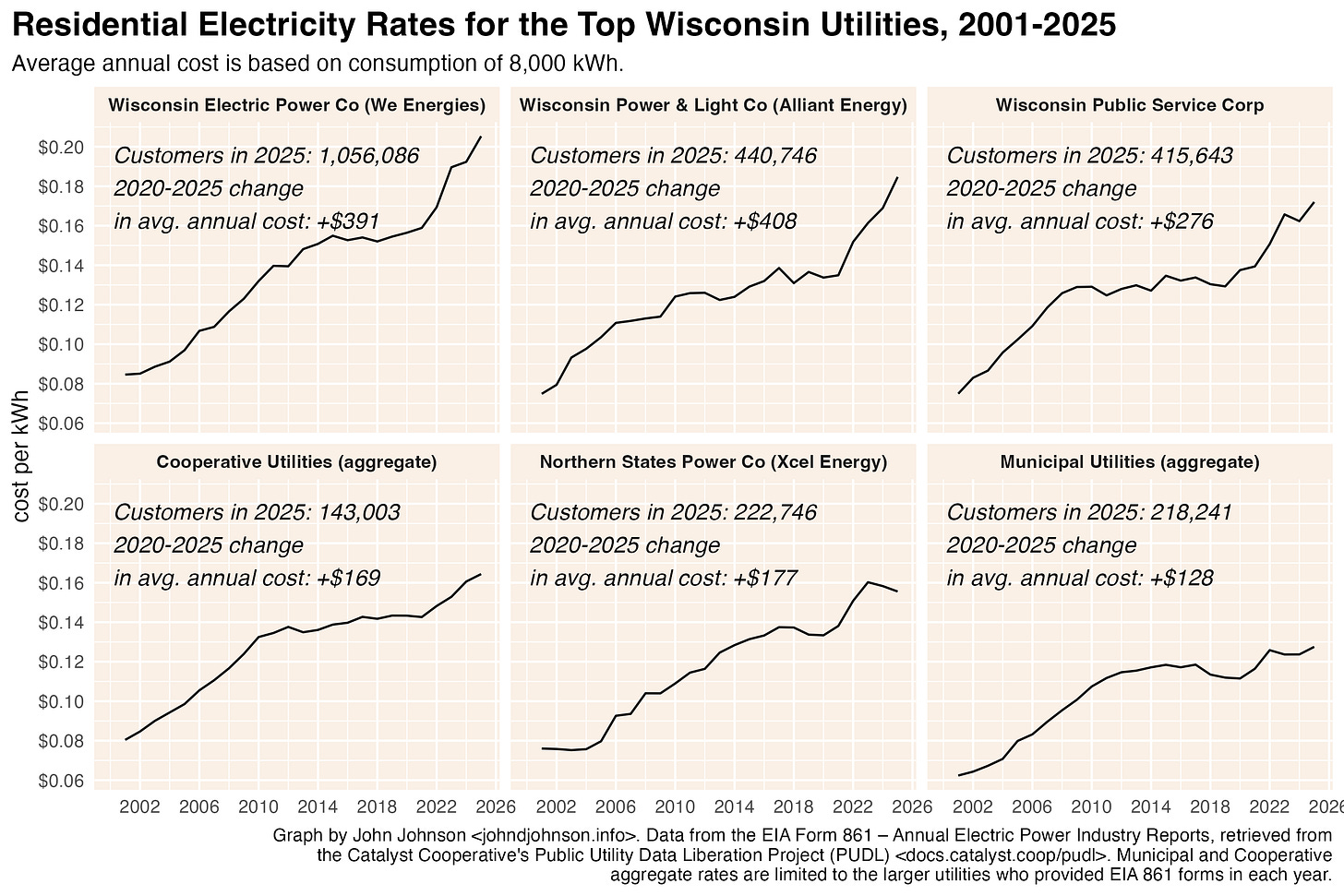
Residential Electricity Rates for the Top Wisconsin Utilities, 2001-2025
Whatever factors have caused Wisconsin’s investor-owned utility rates to jump sharply since 2020 have not affected small municipal utilities or rural cooperatives to the same degree.
[i] The EIA data includes aggregate estimates for the small utilities not reporting. Adding that “adjustment” record to values for municipal and cooperative utilities that did report does not change any of this article’s conclusions. The combined public utilities (cooperatives plus municipals plus adjustment) saw their rates rise by 1.82 cents per kWh (13.8%) from 2020 to 2025, versus 4.3 cents (29%) for investor-owned utilities.
If you think stories like this are important, become a member of Urban Milwaukee and help support real, independent journalism. Plus you get some cool added benefits.