
How the Baroque Era Changed Music
Milwaukee Musaik presents all-Baroque concert featuring brilliant composers and works.
Provided by Milwaukee Musaik.
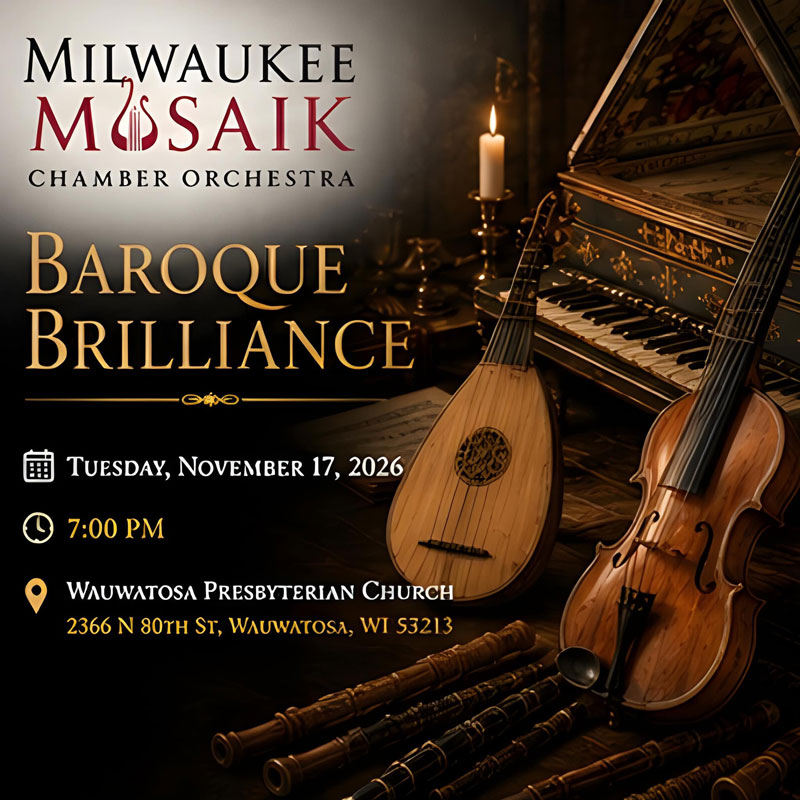
The Milwaukee Musaik chamber orchestra promises sparkling strings, virtuosic winds, infectious rhythms and musical fireworks when it opens its season with “Baroque Brilliance,” a celebration of composers who transformed instrumental music during the Baroque period (1600 to 1750). The concert will be performed on Tuesday evening, Nov. 17.
Italian composer Claudio Monteverdi is recognized as the bridge between Renaissance and Baroque musical styles. In 1605, he proposed grouping music into two categories: prima pratica (first practice) and seconda pratica (second practice). Prima pratica was “the perfection of 16th-century counterpoint…the music of the divine,” writes James Stewart for Vermont Public Radio. But the second practice “allows for these [Renaissance] rules of counterpoint and melody to be broken …”
Thus began a period marked by new forms of composition, technological advancement in instruments, and imaginative performance practices. Musaik’s program spotlights the concerto grosso, “one of the defining instrumental forms of the Baroque era,” according to Musaik conductor Alexander Mandl.
Arcangelo Corelli (1653-1713), a virtuoso violinist and composer, pioneered the concerto grosso, in which multiple soloists (the concertino) engage in dialogue with an accompanying ensemble (the ripieno). Musaik will perform Corelli’s four-movement “Concerto Grosso in F major, Op. 6, No. 6.” Two violins and a cello play solo lines, accompanied by a ripieno group of strings. The “refined melodies, expressive contrasts and graceful interplay make this work a beautiful example of the Italian Baroque tradition,” Mandl noted.
George Frideric Handel (1685-1759) vigorously promoted and refined forms of choral music including operas, oratorios, and cantatas that emerged during the Baroque period. Among his contributions to the concerto grosso repertoire was a set of “Twelve Grand Concertos, Op. 6,” all but two written during a period of five weeks in 1739. The concerti were played during intermissions of Handel’s oratorios; Handel hoped their inclusion would attract larger audiences to his choral performances. The Musaik ensemble will play the first concerto in the set, a five-movement work that employs two solo violinists and a solo cellist. The ripieno includes harpsichord.
Musaik’s program features two works by Antonio Vivaldi (1678-1741), one of the most influential composers of the Italian baroque. His “Chamber Concerto” is scored for flute, oboe, violin, bassoon, and continuo. Vivaldi’s “Concerto in D minor for Two Violins and Cello” is a “musical conversation in which the soloists continually exchange ideas and challenge one another through virtuosic passagework,” Mandl says.
“Baroque Brilliance” will introduce audiences to a pair of lesser-known composers whose writing advanced the Baroque repertoire. Francesco Geminiani (1687-1762), who studied violin with Corelli, based his “Concerto Grosso in D minor” on a set of violin variations Corelli wrote on “La Folia,” a 15th-century Iberian tune. The “Second Concerto in B-flat major” by Unico Wilhelm van Wassenaer (1692-1766) “rewards the listener with elegant melodies, refined counterpoint, and beautifully balanced ensemble writing,” Mandl says.
Milwaukee Musaik will perform “Baroque Brilliance” at 7 p.m. Tuesday, Nov. 17, at Wauwatosa Presbyterian Church, 2366 N. 80th St. Tickets are available online and at the door.

Existing members must be signed in to see the interactive map. Sign in.
If you think stories like this are important, become a member of Urban Milwaukee and help support real, independent journalism. Plus you get some cool added benefits.