Wolf Delisting Fight Puts Wisconsin Governor’s Race In The Crosshairs
Trump’s push to remove protections would hand wolf policy power to whoever wins in November.
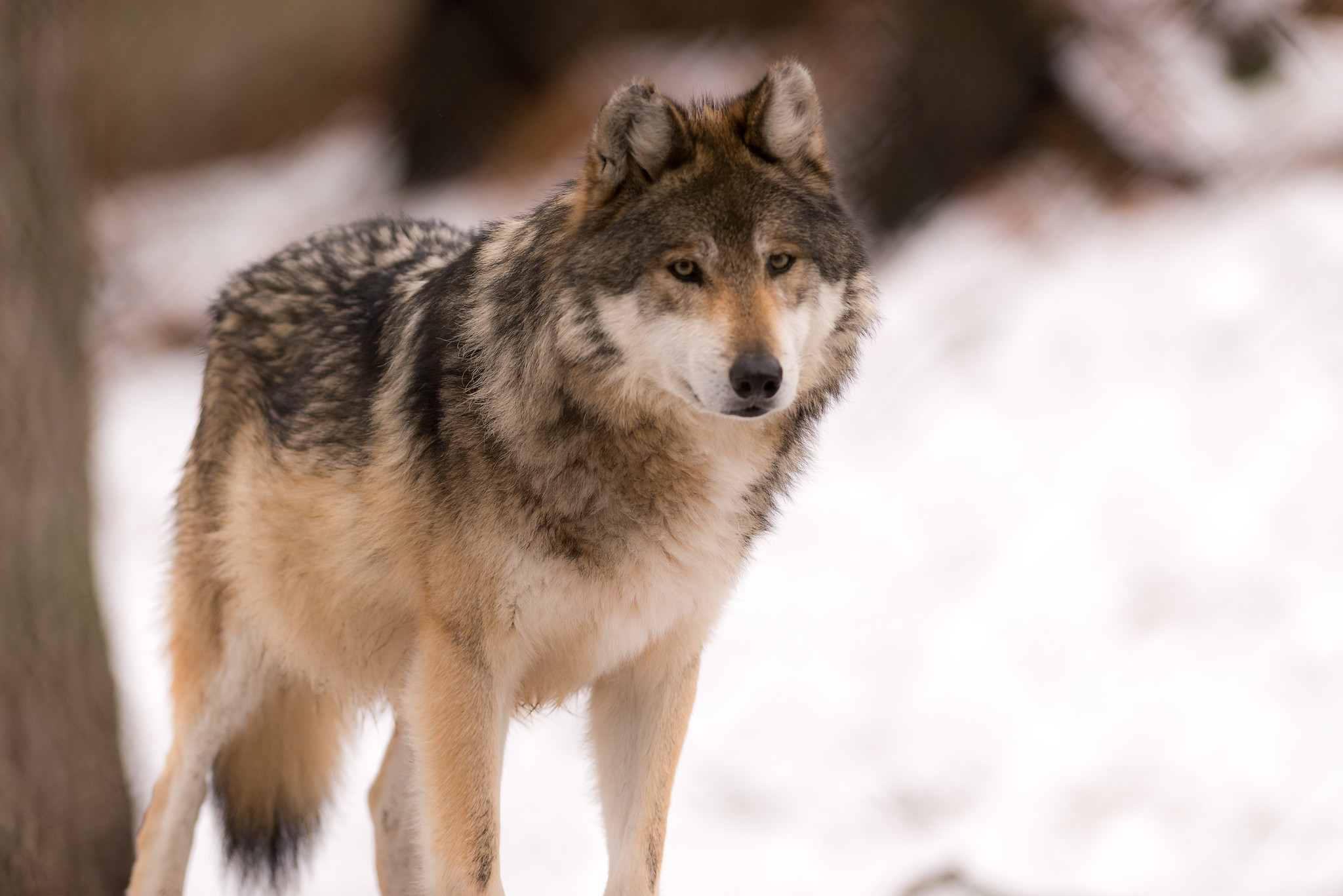
Gray wolf standing in the snow. Eric Kilby (CC BY-SA)
Following President Donald Trump’s executive order earlier this month to remove the gray wolf from the federal endangered species list, Wisconsin’s gubernatorial election will determine the direction of future management of the wolf population in the state.
There are currently about 4,000 wolves across Michigan, Minnesota and Wisconsin, with the Wisconsin Department of Natural Resources estimating the state population number at about 1,162 wolves. The return of the wolf to the state is seen as a conservation success story after the animal’s extirpation in the 1950s.
Trump attempted to delist the wolf during his first term in 2020, but a federal judge reversed that decision two years later. During the two years in which the wolf was delisted, Wisconsin held a controversial hunt of the animal in 2021 in which hunters surpassed the DNR’s quota in less than three days. A state law enacted in 2012 requires that Wisconsin hold a wolf hunt whenever the animal is not on the endangered species list.
The question of Wisconsin’s wolf policy is one of the most heated in the state’s conservation politics. Farmers and residents in the northern part of the state, where most of the wolf population lives, are often more wary of living near the predator. But conservationists and the state’s Native American tribes have sought to protect the wolf as an important part of the ecosystem.
During his time in Congress and the state Legislature, Republican candidate Tom Tiffany has regularly been a vocal advocate for hunting wolves.
“His big priority is wolves. He wants to hunt wolves. I’m not kidding. He’s talked to me about it many times on the House floor,” Michigan Democratic Rep. Haley Stevens said on CNN last month.
As a state legislator, Tiffany was a co-sponsor of a bill to mandate a wolf hunt and the first piece of legislation he ever introduced in Congress was a bill that would have removed the wolf from the endangered species list across the Midwest.
After Trump’s executive order, Tiffany said in a statement that wolves are interacting too often with farmers and families in Wisconsin so they must be hunted.
“Farmers are dealing with livestock depredations, families are losing pets, and wolves are showing up closer to homes,” Tiffany said. “Wisconsin has successfully managed wildlife for generations. It is time to get out-of-state judges and bureaucrats out of the way and let Wisconsin responsibly manage its wolf population.”
So far this year, Wisconsin has had 63 confirmed wolf depredations of livestock, pets and hunting dogs, according to DNR data.
Tiffany’s campaign did not respond to a request for comment.
Democratic candidate David Crowley, the Milwaukee County executive and a former Milwaukee-area state representative, has never represented a part of the state with a wolf population. After Trump’s delisting order, he told Wisconsin Public Radio he supports “commonsense efforts” to return management of the animal to the state.
“While other parts of the country have different wolf populations and management needs, we need our agriculture, tribal, scientific, and impacted communities to come together to create a solution that works for Wisconsin,” Crowley said. “It’s time to follow the science and give impacted communities a seat at the table as we work together to be responsible stewards of Wisconsin’s gray wolf population.”
The decision over delisting will be made by the White House, U.S. Fish and Wildlife Service and the federal court system. Whoever Wisconsin’s next governor is will influence the state’s wolf policy through his power to sign legislation and appoint people to lead the Department of Natural Resources and sit on the Natural Resources Board.
In 2023, the DNR and Natural Resources Board approved the first update to Wisconsin’s wolf management plan since the animal returned in the 1990s. Under the previous plan, the state set a “population goal” at 350 wolves, which at the time was seen as an aspirational aim as the state worked to reestablish the population.
In the decades since that initial plan, the population far surpassed the goal. Anti-wolf advocates began to see that number as their preferred ceiling on the state’s wolf population. Under the current plan, the DNR decided not to set a specific numerical population goal but instead divided the state into zones in which policymakers will assess the biological, social and cultural factors to determine if the local population should be decreased, maintained or allowed to grow.
The state uses a similar method for managing a number of other animals in the state, including bears.
Republicans and their allies among hunting and farming organizations have vehemently objected to the method, repeatedly introducing legislation that would reinstitute the 350 wolf population goal.
“Our policy says that our members would like to see a return to the population goal of 350, and we believe that even under the science the DNR has shown, that that’s a sustainable number,” Tyler Wenzlaff, director of national affairs for the Wisconsin Farm Bureau, told the Wisconsin Examiner. “We in no shape or form are advocating for their removal from the Wisconsin landscape. We know that they’re an integral part of the biological makeup of Wisconsin’s habitat, but we’d like to see some kind of return to a management where they’re controlled a little bit better.”
Wenzlaff said he’d like to see a “gradual decline” of the wolf population toward that number, particularly if Tiffany is the governor and Republicans maintain control of the Legislature.
If Crowley wins and Democrats win majorities in the Legislature, Wenzlaff said the Farm Bureau would work to lobby environmental policymakers on the idea that the wolf has hit its biological and social carrying capacity in the state.
“A wolf population beyond 1,200 to 1,300 is probably not socially acceptable either. And I think if you talk to the DNR, the current number has kind of hovered around this for a couple years now, so they believe that we’re at the biological carrying capacity,” he said. “And I think that anything more than that, you’ll start to see people start to lose that support for wolves once you start seeing animals being taken away, taken off their porch, or you start to see them out in the field when your son or daughter is waiting for the bus in the morning, it starts to get a little bit more real for people. And I think the expansion of the wolf habitat in the last wolf management plan will start to bring that home a little bit as the number increases.”
At a news conference earlier this month, Crowley said that while he believes the state can properly manage a wolf hunt with input from every side of the debate, Tiffany would go much further.
“I do believe that we want to make sure that people can enjoy gaming and different types of recreational outdoor activities here in the state of Wisconsin,” Crowley said. “But I do believe you still need guardrails and making sure that people will be able to hunt wolves the way that they need to, but also making sure that we’re protecting this particular species as much as possible as well. And so, I do think that Congressman Tom Tiffany is going much further than I would like to go when it comes down to wolf delisting.”
Melissa Smith, executive director of the pro-wolf Great Lakes Wildlife Alliance, said in a statement that she would have preferred that Crowley take a strong stance against the delisting. Still, his position is preferable to the lengths to which Tiffany would go.
“Tom Tiffany has made stripping wolves of federal protection the centerpiece of his time in Congress, possibly being one of the most anti-wolf legislators in office right now,” Smith said. “While Wisconsin families are worried about the skyrocketing cost of living, he’s spent his energy on an issue that touches a few dozen of the state’s 58,000 farms. We expect these attacks on wolves to only intensify if given the power of the governorship.”
“David Crowley has also said he supports state management,” she added, “but he’s committed to following the science, and talked about bringing tribes, scientists and affected communities to the table and we’ll hold him to that. It’s clear Wisconsinites value wolves and what they bring to our state, and we look forward to working with the next governor to make sure that’s reflected in how they’re managed.”
Federal wolf delisting would give management power to the next governor was originally published by Wisconsin Examiner.
Political Contributions Tracker
Displaying political contributions between people mentioned in this story. Learn more.