
How Wisconsin’s Governor Candidates Would Address Criminal Justice Issues
Flock cameras, overcrowded prisons and commutations for prisoners are key issues.
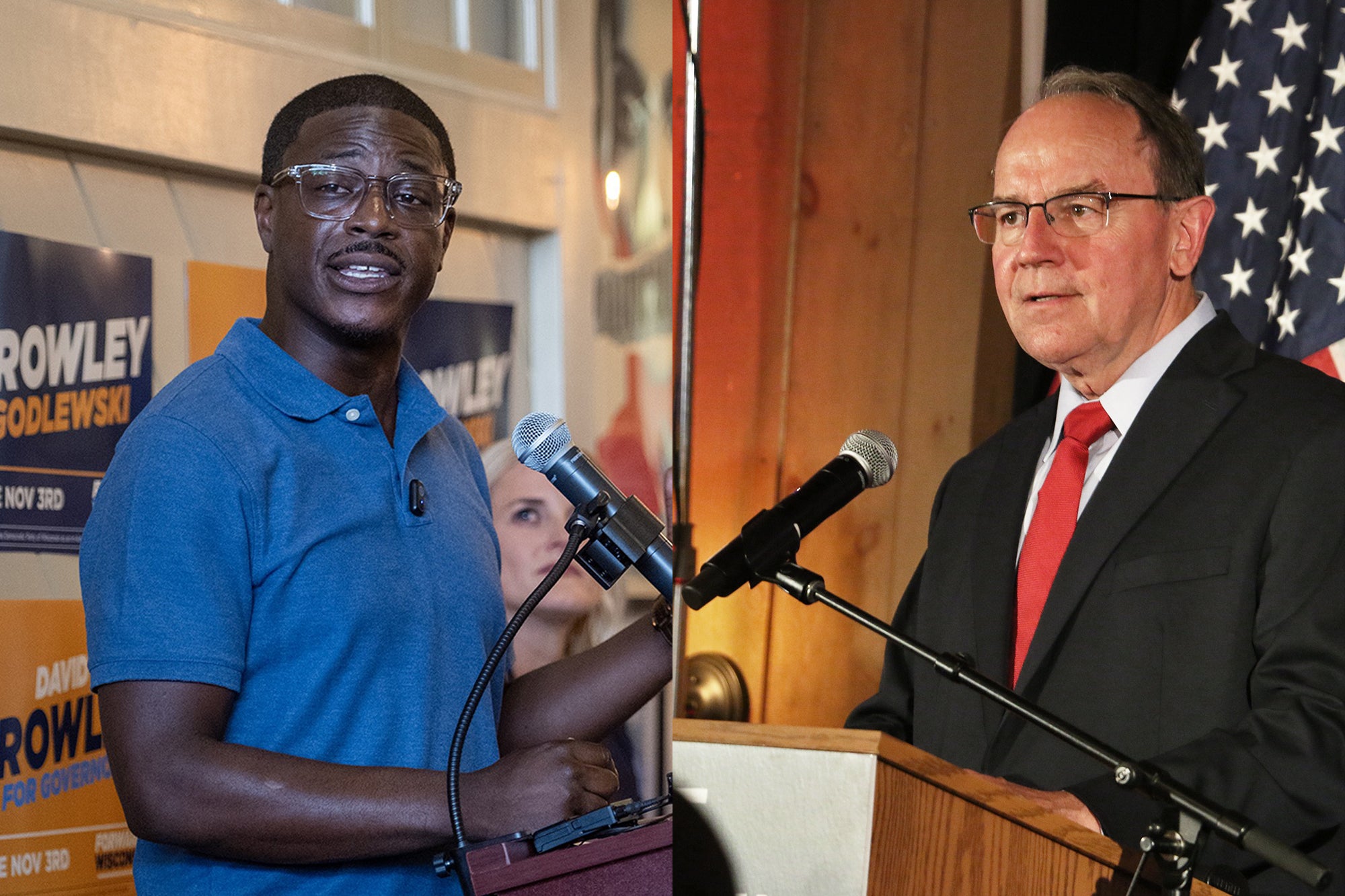
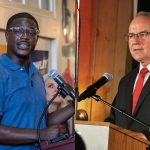
Milwaukee County Executive David Crowley (left) and U.S. Rep Tom Tiffany (right). Angela Major/WPR
From prisons to funding for police, Wisconsin’s next governor will face a lot of decisions related to criminal justice.
On Nov. 3, Wisconsin voters will decide whether the next governor will be Republican Congressman Tom Tiffany or Democratic Milwaukee County Executive David Crowley.
Ahead of the highly anticipated race, WPR reporter Sarah Lehr examined how candidates plan to address crime and punishment. She spoke with WPR’s Courtney Everett on “Morning Edition.”
The following has been edited for clarity and brevity
Courtney Everett: Flock cameras have been in the spotlight in Wisconsin, generating controversy from both sides of the aisle. What have the candidates said about those devices?
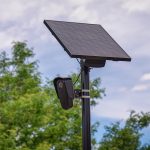
Sarah Lehr: Automated license plate readers made by companies including Flock snap images of every vehicle that passes them by, regardless of whether the driver is suspected of committing a crime
That’s led to privacy lawsuits. And multiple officers in Wisconsin have been charged with misusing the cameras to track exes or romantic partners.
In April, Tiffany responded to a question about Flock cameras, and said he didn’t know what they were.
Since then, Tiffany has spoken more critically about the cameras. In September, he said that if he were governor he’d push to bar municipalities from using shared revenue from the state to purchase ALPR cameras.
The state’s Republican Party also went after the use of Flock cameras in Milwaukee County, where Crowley is the county executive. They called him “Big Brother Crowley.”
Recently, Milwaukee County has been pulling away from Flock camera use. Earlier this month, Crowley signed a resolution, ordering those cameras to be removed from county parks.
CE: Wisconsin’s governor oversees the Department of Corrections, one of the state’s biggest agencies with a budget in the billions of dollars. This election season comes as Wisconsin’s prison population has reached a record high. Have the candidates expressed concern about that?
SL: DOC is in fact a huge agency — it has more than 10,000 employees.
More than 23,000 adults locked up in state prisons; 60,000 more people are under DOC oversight as part of probation, parole or extended supervision
Crowley expressed support for decreasing Wisconsin’s prison population through measures such as investing in mental health. He’s expressed concerns about the high financial costs of the state’s prison system
As one way to reduce the prison population, Crowley said he wants to end what’s known as crimeless revocation. That’s when someone gets sent back to prison for a technical violation of their parole or extended supervision rather than because they were charged with a new crime
Tiffany says he would not push to end crimeless revocations. He said if someone violates the conditions of their release they need to face accountability and in a statement earlier this year, he accused Democrats of protecting “criminals rather than victims.
CE: On the topic of prisons: State reports show that many of Wisconsin’s prisons aren’t up to modern codes and need hundreds of millions of dollars in repairs. What do the candidates say about the future of those facilities?
SL: In response to questions from WPR, Tiffany say he supports “safely closing” the Green Bay Correctional Institution; It’s a 128-year-old maximum security prison that’s been troubled by violence and crumbling infrastructure. Crowley’s campaign sent a statement saying he supports “advancing conversations” about closing Green Bay but didn’t directly commit to having it closed
It’s worth noting that many criminal justice reform advocates want Wisconsin to cut back its prison population so that Green Bay can close without being replaced. Tiffany does not agree with that. In a statement to WPR, he made it clear that he thinks Wisconsin needs to build prison capacity elsewhere in order for the Green Bay Prison to close.
The outgoing Democratic Governor Tony Evers has advanced a plan to close that prison and its eventual closure has bipartisan support, including from Republicans in the Green Bay area.
CE: The governor in this state has the power to cut short criminal sentences by handing down commutations. Is that a power Tiffany or Crowley would use?
SL: Zooming out a little: Commutations used to be used by governors of both parties. It’s a way to shorten someone’s time in prison or on community supervision. But, over the last several decades, governors in this state have stopped using that power
Now, commutations are in the news again because Evers is working to bring them back. He’s on track to give out his first commutations before he leaves office at the end of the year. And he’s set up a board to advise him on applications from people who are seeking that type of mercy.
Tiffany has criticized the way Evers has gone about that process; he called the commutations panel the governor’s “soft-on-crime board.” Tiffany did not answer a question from WPR about whether he would issue any commutations if elected governor
In contrast, Crowley praised Evers for restarting commutations. Crowley says it’s a valuable tool in response to excessive sentences or situations where people can prove that they’ve been rehabilitated. But he also emphasized that public safety and respect for victims needs to come first
Both Crowley and Tiffany have pledged that they will not give out commutations for violent crimes, including murder.
How Wisconsin’s governor candidates would address criminal justice decisions was originally published by Wisconsin Public Radio.
If you think stories like this are important, become a member of Urban Milwaukee and help support real, independent journalism. Plus you get some cool added benefits.
Political Contributions Tracker
Displaying political contributions between people mentioned in this story. Learn more.