
Wisconsin’s 988 Crisis Lifeline a Success But Faces Funding Shortage
Despite bipartisan support for it, legislators haven't provided permanent funding.
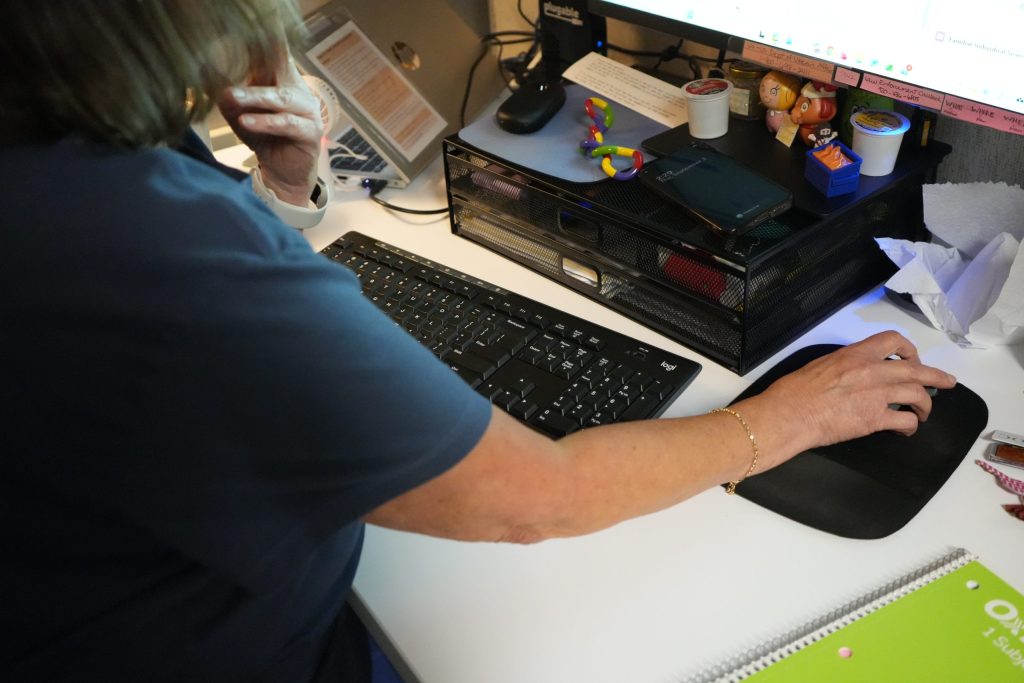
A counselor responds to calls and chats to the 988 Suicide and Crisis Lifeline at Family Services of Northeast Wisconsin in Green Bay, Wis., on Sept. 3, 2026. The service has received more than 345,000 texts or calls since it launched in July 2022. (Astrid Code / Wisconsin Watch)
Every year, millions of people in crisis dial three numbers — not 911, but 988, the national suicide and crisis lifeline. People like Cadence Van Beek, who used the lifeline as a sophomore at Melrose-Mindoro High School in Melrose.
During a mental health crisis, Van Beek worried she would be placed on a waitlist or hurried through the process. Instead, a counselor patiently helped her de-escalate her feelings. At the end, she informed Van Beek about local resources in Jackson County.
“It didn’t feel rushed … She took her time with me, and she was very kind – just a kind soul,” she said.
Van Beek’s conversation is one of over 345,000 texts or calls to the state lifeline since its launch in July 2022. A recent JAMA study found that in the first two and a half years, suicides among 15- to 34-year-olds were 11% lower than expected, corresponding to nearly 4,400 fewer deaths.
Yet despite the line’s proven success and increased demand, long-term funding remains uncertain. Unlike other states, Wisconsin has not passed legislation to permanently fund the service. And Wisconsin trails most states in the share of calls answered in-state.
In May, Van Beek visited the state Capitol and presented lawmakers with a solution: Fund 988 like 911.
Since 2009, Wisconsinites have paid a telecommunications fee on their phone bills for 911, currently 75 cents per month. Twelve states, including Illinois and Minnesota, have enacted a 988 fee to fund the service.
Illinois and Minnesota had in-state response rates of 90% in July — compared with Wisconsin’s 81%. The rest of the calls are routed to a national backup center, which can mean less knowledge of local resources and longer wait times.
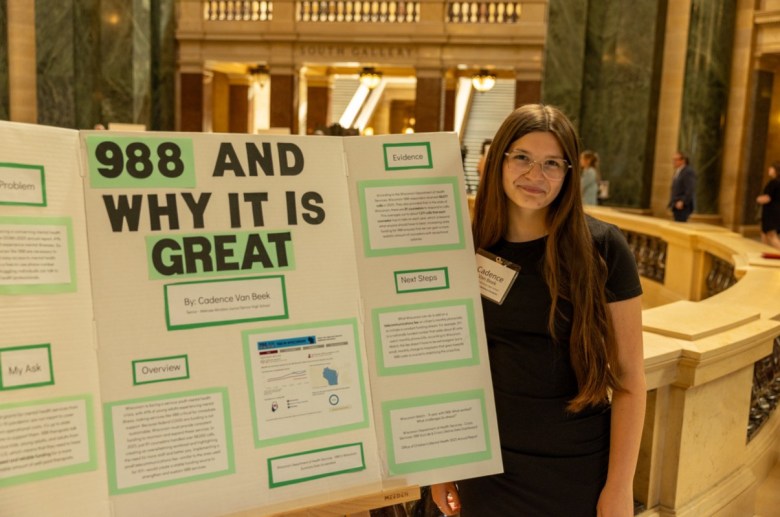
Cadence Van Beek presents her 988 funding recommendation at the state Capitol in Madison with the Office of Children’s Mental Health in May 2026. (Courtesy of Cadence Van Beek)
When Van Beek visited Madison with the Wisconsin Office of Children’s Mental Health, she set up a posterboard with her research and told legislators her peers rely on 988.
“988 has always kind of been a given,” she told Wisconsin Watch. “We always kind of assume that it’ll be there … The possibility that there might not be enough counselors on the line because of funding for 988 and funding for those counselors just makes me a little worried.”
State struggles to keep up with increased demand
Family Services of Northeast Wisconsin operates Wisconsin’s 988 line. Senior Vice President Tana Koss said the crisis team planned for a moderate to high level of calls when the three-digit number was launched in 2022.
“Still, Wisconsin has blown all numbers out of the water and continues to … The demand from Wisconsinites for this service has surpassed every model of projection that was available to us,” Koss said.
Family Services is still recruiting counselors to keep up with the need. Koss attributes the increase to lingering mental health effects from the COVID-19 pandemic and the lifeline’s accessibility. She celebrates more people using the service, which she views as a reflection of reduced stigma.
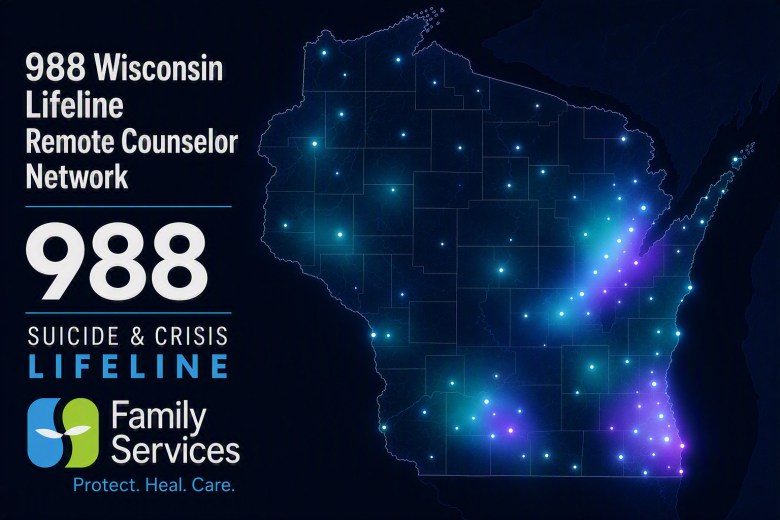
Even though Family Services of Northeast Wisconsin is located in Green Bay, the state’s 988 Suicide and Crisis Lifeline counselors work remotely from home offices across the state. (Courtesy of Family Services)
Wisconsin received over 11,200 calls in July alone – and responded to just over 9,000 of them in-state. Only eight states had the same or worse in-state response than Wisconsin.
“The longer a person waits on the line, the more likely they are to disengage … When you’re in queue, our primary center gets an opportunity to answer. If we’re not able to, then our backup center gets an opportunity to answer. And then, if they’re not able to, it goes to national backup,” Koss said. “So the sooner in that process you can have the staff available, the more likely you are to engage that caller.”
Still, the state has improved its answer rate over the past few months — growing from 74% in January to 81% in July as demand increased.
“Purely from the administration of the service … we want (the answer rate) to get to 90%, and had the growth not gone up even a little bit more than anticipated, we would have been there.” Koss said.
So, should Wisconsin officials enact a 988 fee, a recurring appropriation or even consider legislation that Ohio and Illinois lawmakers have introduced to fine AI companies for failing to address suicidal ideation? Koss doesn’t care, as long as it means Wisconsin won’t have to depend on federal funding or the state’s biennial budget cycle.
“I’m not personally attached to any route,” she said. “I think the request that I would have and advocate for is sustainability over the long haul because what we’re projecting is this growth hasn’t stopped.”
The case for state funding
Every two years, the National Alliance on Mental Illness’s Wisconsin chapter pushes for 988 funding in the state budget, said Julia Polk, the group’s advocacy coordinator. Last year, Gov. Tony Evers’ budget recommended $12.2 million for the lifeline, but lawmakers approved $7 million.
“What we would love to see is that we can educate our legislators on why 988 is so important and why it’s important to fund it long term, and get them in the next state budget to say, ‘we’re going to permanently fund this,” Polk said.
Polk also said delays from the Trump administration in making grants available are part of why advocates want to secure reliable state funding for the lifeline.
“It’s a lot of us and other advocates, and the 988 Lifeline and the state government having to just trust and hope that those grants will become available,” she said.
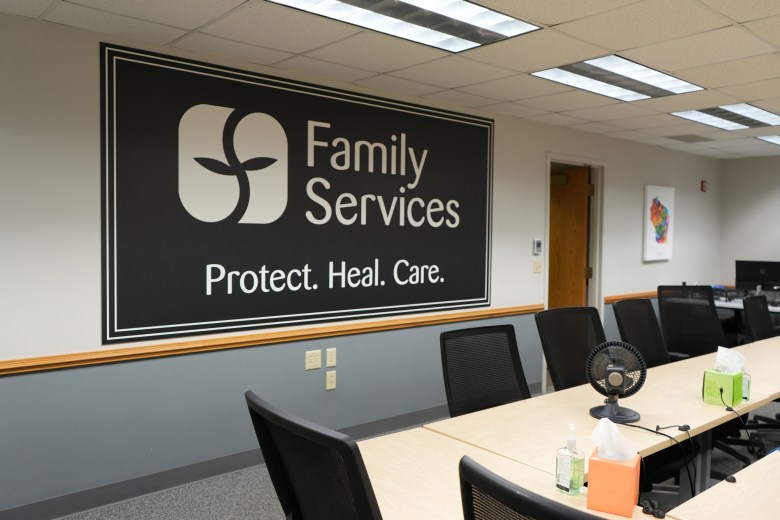
Family Services of Northeast Wisconsin operates the 988 Suicide and Crisis Lifeline for the entire state of Wisconsin. The organization is based in Green Bay but employs remote counselors throughout the state who respond to 988 calls, text messages and chats. (Astrid Code / Wisconsin Watch)
Waiting for confirmation on an anticipated federal grant last year left officials fearing the funds had disappeared. In response, state Rep. Ben Franklin, R-De Pere, and state Sen. Jesse James, R-Thorp, authored a bill that would have required the state to provide grants to agencies that administer the 988 Lifeline.
“988 has proven to be highly effective and used frequently amongst Wisconsinites and is a vital service we should be funding,” Franklin said during a committee hearing on the bill in June 2025.
However, the bill included no funding attached. It failed to pass in the Senate and did not come up for a vote in the Assembly.
The federal government announced a grant funding opportunity in January and provided Family Services about $4.5 million per year for the next three years, according to Koss. But that still leaves a gap, since the state needs $12.2 million per year to fund the service.
Officials included $7 million for the lifeline in the 2025-27 biennial budget, but Koss said Family Services needs the next budget to match that. She knows a $6.195 million deficit is coming in 2028.
“We didn’t slow down with recruitment, but administratively, it’s stressful when you have these delays on giant parts of the funding,” Koss said.
Franklin’s Democratic opponent in the November election, Brandy Tollefson, is a De Pere School Board member. The issue is personal to her, and not just because she hears about the youth mental health crisis from school social workers, counselors and teachers.
“I myself went through the experience of having my stepbrother die by suicide years ago, so I know what happens to a family when this happens and the impact it has on families,” Tollefson said. “I fully support working with any Democrat or Republican who wants to get this permanently funded.”
Tollefson echoed other Democrats’ criticisms that Assembly Bill 303 lacked the critical funding needed to ensure 988 would get financial support. Franklin did not respond to requests for comment in time for publication.
“There was a lot missing from it to make it a bipartisan bill that people could get behind, because the details just weren’t there,” Tollefson said.
Connecting with younger generations
Megan Zimmerman, NAMI Fox Valley’s outreach program director, educates local schools about mental health and promotes 988. She said many people hesitate to call 988 because they fear emergency services will get involved, but in reality, law enforcement or emergency services respond to only 0.4% of callers in Wisconsin. Counselors resolved the other 99.6% of calls by providing support, coping strategies and resources.
“Even outside of 988, I think when someone expresses that they have suicidal ideation – like they’re having thoughts about it – I think that scares people,” Zimmerman said. “They almost immediately triage to like, ‘OK, this person needs to be hospitalized.’”
Zimmerman noted the person who calls 988 doesn’t have to be the one who is in crisis, as she often calls 988 with her clients.
“If I can get an individual to agree to have that conversation on the phone with someone, and I’m there to support them in whatever way they need, that is just as good of an outcome as telling them to go home and call it themselves, which they may or may not follow through on,” she said.
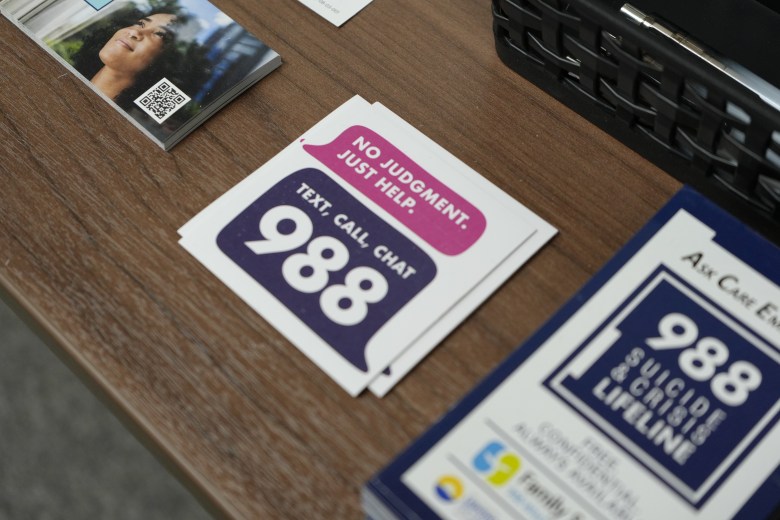
Cards used to spread awareness about the 988 Suicide and Crisis Lifeline are seen at the Family Services of Northeast Wisconsin’s office in Green Bay, Wis., on Sept. 3, 2026. (Astrid Code / Wisconsin Watch)
Van Beek, who always considered herself the “therapist friend,” often recommends 988 to peers who confide in her. Once, when a friend shared distressing details about her home life, Van Beek quickly realized she wasn’t equipped to handle the conversation.
“I just realized I’m a high school kid, and I can’t take this on,” Van Beek said. “I don’t have the knowledge to help you get to where you need to be with the situation. So that’s an instance where I recommended calling or texting 988 and just going through with that. And she did.”
The 24/7 chat feature, introduced in 2024, particularly appeals to her generation and was helpful when she had to use it.
“Gen Z in general, we’ve always been behind a screen,” Van Beek said. “988 gives youth the option to text it, and I always have liked that, because talking or maybe even going in person can be overwhelming for youth, and I can personally relate to that.”
Amid increasing reports of generative AI enabling suicides, proposed legislation in Illinois would fine AI companies for not addressing suicidal ideation and deposit the money into a 988 trust fund. Companies under the legislation would face a penalty of up to $15,000 per day if they don’t refer users to crisis services like 988 when they express thoughts of self-harm.
Zimmerman said the chat feature of 988 has led her to encourage students to message the lifeline instead of an AI companion.
“Every suicide prevention presentation I give, especially in a school, I just always stress (that) I know it’s easy to bring up ChatGPT or your Claude or your Gemini or whatever it is, and start essentially texting or chatting that feature,” Zimmerman said. “But I always really encourage people to instead think about 988 … because then you’re getting a real live human being.”
Having graduated as president of her high school’s Raise Your Voice mental health advocacy club, Van Beek recently began studying psychology at the University of Wisconsin-Whitewater, where she wants to continue raising awareness about mental health.
“The events that I participate in, whether it’s through NAMI or NAMIWalks — the mental health walk that we do — it has never felt like a chore to me,” Van Beek said. “I’ve always felt like that’s my purpose.”
This story was produced as part of the NEW (Northeast Wisconsin) News Lab, a consortium of five news outlets.
This article first appeared on Wisconsin Watch and is republished here under a Creative Commons Attribution-NoDerivatives 4.0 International License.