
911 Officials Pledge Transparency, Then Walk Out
Briefing on botched response to 99-year-old woman’s beating raises new doubts.
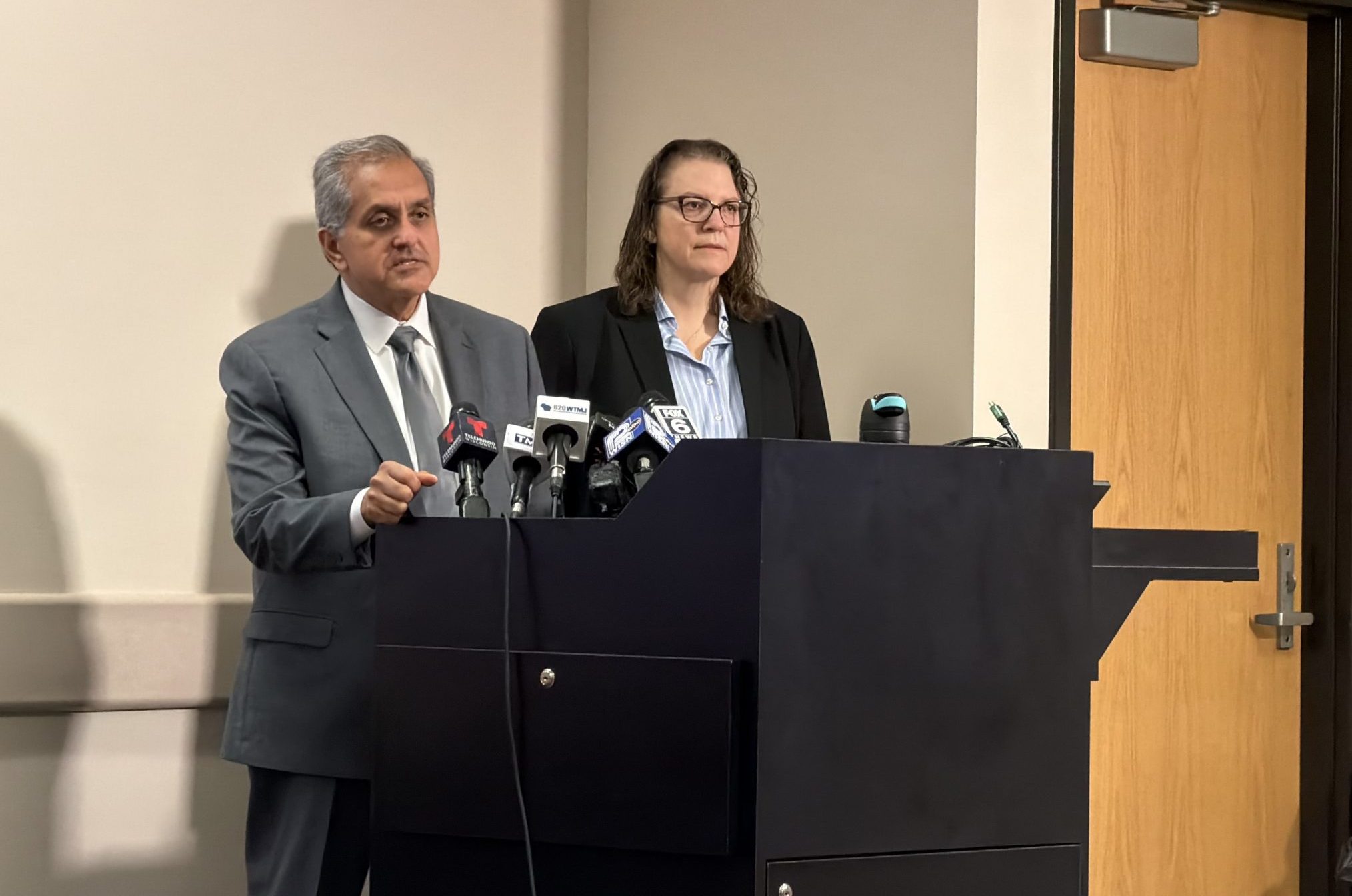
Tony Bueno and Annemarie Domurat. Photo by Jeramey Jannene.
Milwaukee’s emergency communications officials repeatedly promised transparency Wednesday as they discussed the botched handling of a 911 call involving the beating of a 99-year-old woman.
Then, after taking just two questions, they left.
The city’s Department of Emergency Communications called the news conference to discuss the results of its investigation into the July 27 incident, in which two 911 call-takers failed to trigger an immediate emergency response despite increasingly explicit evidence that an elderly woman was being attacked inside her home.
DEC Director Tony Bueno announced that two unidentified employees involved in the incident had resigned or “separated.” A third employee, a dispatcher, remains employed and will receive additional training.
But Bueno offered little explanation for how the failures occurred, what the dispatcher specifically needed to improve, or what changes DEC would make to prevent a similar incident.
Instead, officials spent much of the approximately 10-minute briefing defending the department’s existing training program and discussing accreditation they intend to pursue.
“Our training is extensive,” Bueno said when asked what would change as a result of the incident. He said the department’s training meets or exceeds national benchmarks and best practices.
That answer came shortly after Bueno described the additional instruction being given to the dispatcher as essentially routine professional development.
“It’s really just a matter of refining our skill sets,” Bueno said. He characterized the additional training as an opportunity to help the employee grow and receive “tips and tricks,” rather than identifying a specific failing exposed by the July 27 incident.
Bueno opened the briefing, held in the DEC’s offices and call center above the Milwaukee Police Department’s District 3 station at 4923 W. Lisbon Ave., by acknowledging the seriousness of what happened and repeatedly stressing his desire for transparency. He said DEC’s investigation was initiated before the incident was reported in the press and included reviews of the calls, department policies, standard operating procedures and training materials.
He also said he had hoped to distribute an investigative summary Wednesday but was advised by the City Attorney’s Office that employee due process and open-records requirements prevented its immediate release.
Bueno said two employees had resigned but did not clarify whether their resignations were voluntary or in lieu of termination. Urban Milwaukee has submitted a records request for more information. He said investigators did not determine that the dispatcher, a higher-level employee than the front-line call takers, violated DEC policies or procedures, but said the employee would receive additional training.
“This doesn’t stop with individual employees,” Bueno said, describing a responsibility to determine what the department could learn from the incident.
DEC Deputy Director Annemarie Domurat said the department intends to seek accreditation from the Commission on Accreditation for Law Enforcement Agencies and certification of its training program through the Association of Public-Safety Communications Officials International.
The agency has previously touted its training operation. In January, DEC held a news conference to announce the use of artificial intelligence software to train and evaluate its operators. Bueno described the technology then as an investment in “people, process and accountability.” The department said new operators receive weeks of classroom instruction, followed by on-the-job training.
Wednesday, officials again emphasized the breadth of that training.
But the July 27 incident presents an extraordinary example of the system failing despite it.
Bueno was hired to lead the newly created DEC in 2024 following the merger of the city’s police and fire 911 call centers. He previously worked in Salt Lake City.
Woman Waited Hours For Help
The incident that raised all this fuss began at 5:16 a.m. July 27, when an employee of a medical alert company called Milwaukee’s 911 center and reported what the worker believed was an ongoing domestic violence incident involving a 99-year-old woman.
The employee reported hearing a man threaten the woman.
The call was classified as a priority-three incident, which did not result in an immediate dispatch.
Approximately five minutes later, the medical alert worker called again and reached a different employee.
“I just don’t feel right about this,” the worker told the 911 operator.
The worker connected the dispatcher to live audio from inside the home. A woman could be heard crying and moaning in pain while a man yelled at her. The medical alert employee specifically told the dispatcher it sounded like a man was kicking an elderly woman on the floor.
The dispatcher acknowledged hearing what was occurring.
Still, no emergency responders were immediately sent.
The 99-year-old victim ultimately called 911 herself at approximately 7:50 a.m., more than two and a half hours after the initial report. She told the operator she had been attacked and had crawled across the floor to reach a phone.
Medical responders were dispatched shortly afterward to the southside home near S. 14th Street and W. Cudahy Ave. Police ultimately arrested Joseph G. Macias, 23, who prosecutors subsequently charged with burglary, battery and first-degree reckless injury. Macias, through attorney Michael Chernin, requested a doctor’s evaluation to support a potential plea of not guilty by reason of insanity or mental defect.
Bueno previously acknowledged that the first calls should have been handled with greater urgency.
Wednesday’s press conference was supposed to provide more answers about how that failure occurred.
It instead generated new questions about DEC’s willingness to answer questions at all.
“What Was the Point of This?”
Near the end of the briefing, Bueno noted that the department had only a limited amount of time for further discussion. A staff member then announced there was time for “a couple of questions.”
Reporters asked two.
When journalists attempted to continue questioning officials, DEC staff cited a scheduling conflict involving the use of the room.
“We do want to be as transparent as possible,” said a DEC staff member as Bueno and Domurat quietly exited the room through a backdoor.
Urban Milwaukee offered to continue the press conference in the hallway or another location. The staffer declined.
Staff instead told reporters they could submit additional questions by email and said answers would be provided in a “timely” manner.
Asked what “timely” meant, the staff member could not provide a timeframe.
The abrupt ending drew audible frustration from reporters who had assembled for the department-called event.
“So then what was the point of this?” one reporter asked. “This could have been sent in an email.”
Another reporter pressed officials about when emailed questions would actually be answered.
“What’s the timely manner for email, and how do we know more information because we don’t really get much information?” the reporter asked.
The DEC employee said she did not have a timeline.
One reporter summarized the exercise after officials had departed:
“There was no point in being here.”
If you think stories like this are important, become a member of Urban Milwaukee and help support real, independent journalism. Plus you get some cool added benefits.