The Music of Revolutionary America
It's quite an unusual mixture, as concert by Newberry Consort will demonstrate.
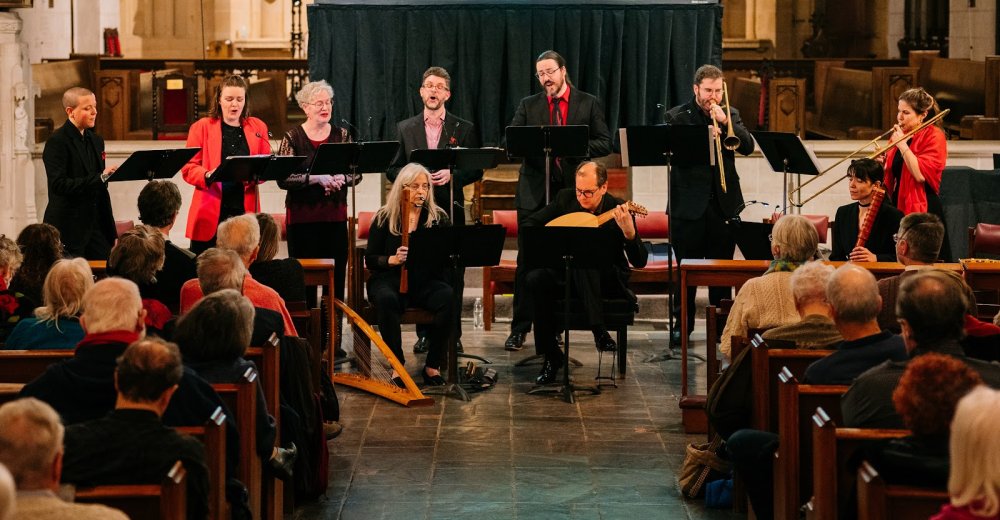
The Newberry Consort. Photo from Early Music Now.
What did early America sound like? Early Music Now’s season-closing program featuring the Newberry Consort offers a richly researched answer in Revolution! — the program at this Saturday’s concert at Saint Joseph’s Chapel. The answer may be an unexpected one. Artistic director Liza Malamut, speaking ahead of the performances, cuts straight to the heart of it: “There was no national music. There was no one style, no composer that everybody living in North America during this time period would have identified as the national music of America.”
What existed instead was a continent of cultural pockets — communities whose music owed far more to their own ancestral traditions, sacred practices, and local circumstances than to any shared American identity. Revolution! takes that plurality seriously, presenting a program organized not as a single national story but as a collection of distinct musical worlds, each with its own instruments, languages and purposes.
The program spans the founding era through the eve of the Civil War, drawing on sacred music, military song, parlor entertainment, political satire, and community hymnody — each tradition reflecting the specific world that produced it. The broadside ballads brought from England, the shape-note hymns of rural New England, the trombone choirs of Moravian settlements, the Choctaw hymnal, and the African American spiritual all lived side by side in early America without merging into a single sound.
Audiences accustomed to early music programs rooted in the European classical tradition may find some of the repertoire unfamiliar in style. But Malamut cautions against drawing sharp lines between folk and classical: “That melting of classical and folk music was something more common than we realized, both in Europe and early America.”
William Billings’s Lamentation over Boston — a wrenching paraphrase of “By the Rivers of Babylon” written during the Revolution — sounds almost like an English madrigal, yet it is also closely tied to the shape-note singing tradition most listeners would call folk. The salon set features Francis Hopkinson, a signer of the Declaration of Independence who composed in the fashionable European style, alongside Benjamin Carr’s Rondo in E-flat — chamber music that would not have been out of place in Vienna. The second-half virtuosity set includes a polonaise for keyed bugle and a flashy violin solo, “The Cuckoo,” whose subject was popularized by Vivaldi in the Four Seasons. “Early America’s tradition with art music was less developed,” Malamut notes, “so you had a lot more overlap and evolution of the music during this time period.”
One of the program’s most distinctive sections draws on the music of the Moravians, a German Protestant sect that established missions across North America and brought with them the tradition of trombone choirs — four-part ensembles used not only for worship but to call communities to weddings, funerals, and feasts.
The Moravian mission story is also one of cultural encounter. When Moravian missionaries worked among Native communities, the resulting music reflected both appropriation and genuine integration. The Mohican hymn on the program, Māamāanaakhumuweenāanā, was contributed by musicologist Sarah Eyerly. It represents a Mohican voice shaped by, but not reducible to, Moravian influence.
The Choctaw set, arranged by violinist and Native American music scholar Brandi Berry Benson, comes from a separate tradition entirely. The Choctaw hymnal — one of the most distinctive American Indian hymn traditions of the nineteenth century — contains both European hymns translated into Choctaw and hymns composed by Choctaws themselves.
The ensemble performs on period instruments spanning the entire era covered by the program. The square piano — played by fortepianist Sylvia Berry — is an original 1795 John Broadwood & Son instrument built during George Washington’s second term. Its sound is softer and more intimate than later pianos, with a silvery, “gossamer” quality suited to the salon repertoire it accompanies.
Other period instruments include keyed bugles and a cornopean — a forerunner of the modern cornet; a classical period flute and military fife; a rope-tension snare drum of the kind used by Revolutionary-era military units; and the four German classical trombones that anchor the Moravian sections. Malamut and her colleagues have chosen instruments that “cover the greatest number of repertoires while also being the most flexible” — a practical necessity when the program ranges from a 1782 Sephardi synagogue hymn to an 1844 march honoring Haitian independence.
See the Newberry Consort website for more details on the 15 singers and instrumentalists in this concert.
The program closes with “When Shall America,” a new work for period instruments and voices by bass-baritone and composer Jonathan Woody — the first commissioned composition in the Newberry Consort’s history. Drawing on the poetry of Phillis Wheatley and Lemuel Haynes, Woody weaves together shape-note singing, 17th-century German polyphony, fife and drum, and Haydn-inspired piano music into a meditation on the American experiment’s unfulfilled promises.
A program born of the challenge to celebrate the United States’ 250th anniversary rises to the occasion by celebrating the nation’s diversity.
The Newberry Consort will perform at Saint Joseph Chapel, 1515 S. Layton Blvd. at 5 pm on Saturday, May 9. A pre-talk will begin at 4 pm. Purchase tickets at 414-225-3113, online, or at the door.
After attending the concert, you may wish to recommend a streaming of the premiere event, first performed this week in Chicago, available in June.

Existing members must be signed in to see the interactive map. Sign in.
If you think stories like this are important, become a member of Urban Milwaukee and help support real, independent journalism. Plus you get some cool added benefits.