
Pete Buttigieg Comes to La Crosse
Democrat offers hope and urges 'the politics of courage' to western Wisconsin.
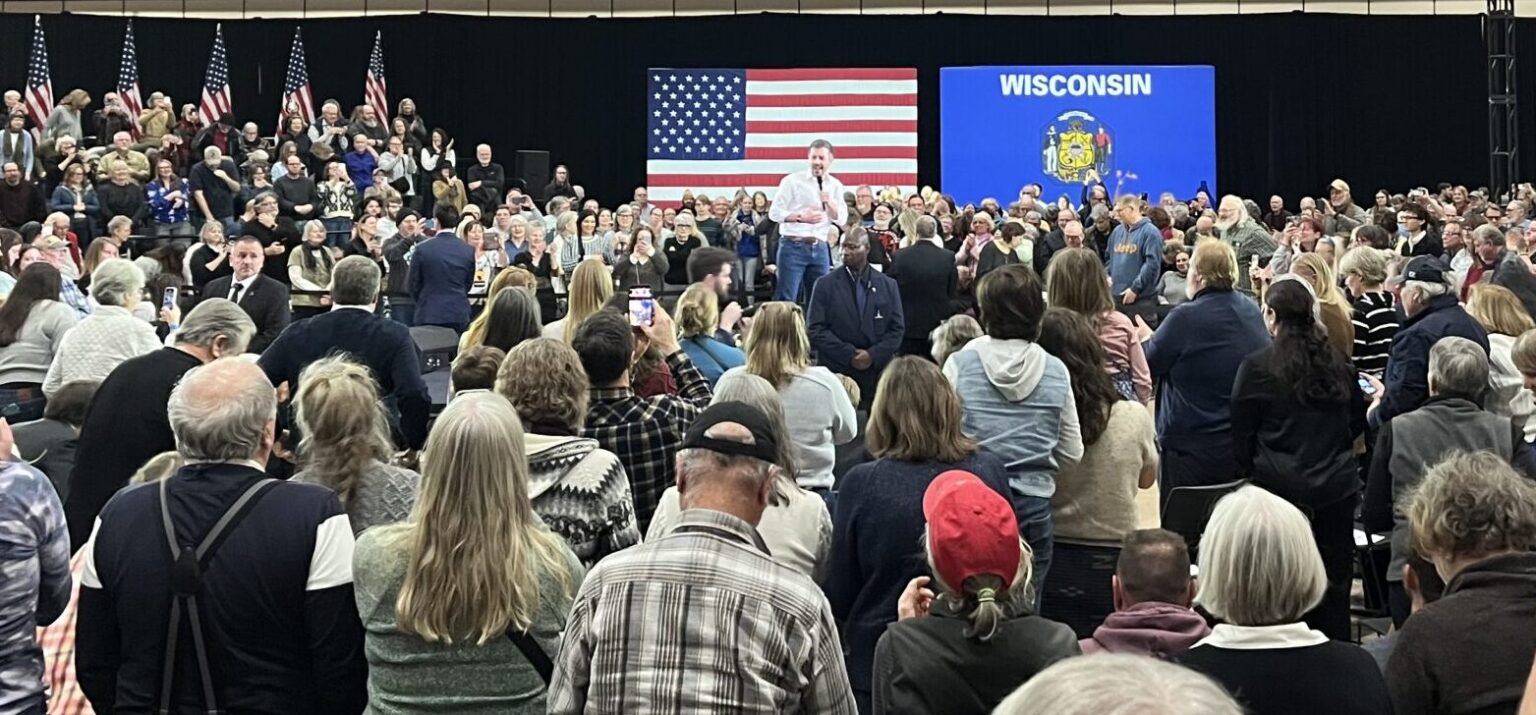
Pete Buttigieg speaks at a town hall in La Crosse, Wis. on Jan. 16, 2026. | Photo by Ruth Conniff/Wisconsin Examiner
Dairy farmers and U.S. military veterans were heavily represented among the hundreds of voters from western Wisconsin and Minnesota who packed the La Crosse convention center Friday night, braving snow and freezing temperatures to hear what former U.S. Transportation Secretary Pete Buttigieg had to say about our current political predicament.
Buttigieg was following in the footsteps of other Democrats who have visited Wisconsin’s closely divided 3rd Congressional District to needle Republican U.S. Rep. Derrick Van Orden for failing to meet publicly with his constituents who are bearing the brunt of tariffs, high prices and unaffordable health care spurred by Trump administration policies Van Orden has supported.
In making his La Crosse appearance to bolster a Democratic candidate in a swing district ahead of the midterms — and perhaps to stick his toe in the water ahead of a potential 2028 presidential run — Buttigieg connected with rural and blue-collar Midwestern voters.That’s something Democrats arguably need to do better if they are going to overcome total domination by the party of President Donald Trump.
The most interesting thing about the La Crosse town hall was the energized audience of rural and small-town Wisconsin and Minnesota residents worried about the scary, violent authoritarian regime that is rapidly consolidating its power over a stunned and fractured citizenry.
Democratic state Sen. Brad Pfaff, who took the stage ahead of Buttigieg, praised him as “a son of the Midwest,” denounced President Donald Trump’s gilded White House ballroom, and declared, “The rich get tax breaks and what do the rest of us get? Rising costs!” Pfaff also took a jab at “tech bros” who got front-row seats at Trump’s inauguration and are profiting from algorithms that sow “hate and distrust and division.”
Buttigieg picked up on that theme, urging people to reach out in person to connect with their neighbors who might disagree with them. Responding to a veteran in the audience who said he was in despair about talking to people who live in a pro-Trump social media bubble and who “don’t know how close to the abyss we really are,” Buttigeig said, ”This is where I believe in the power of the offline.”
“We are increasingly sorted into these silos where not just our opinions, but our facts, or would-be facts, are presented to us. But our relationships, our families, our neighborhoods, our communities, our churches, our little league, our sports loyalty, right? That’s where we have a chance to get through to people.”
Rebecca Cooke, who lost her challenge to Van Orden in 2024 by three percentage points and is seeking a rematch, used her few minutes on stage ahead of Buttigieg to emphasize her dairy farm upbringing and work experience as a waitress, declaring, “I’m a working-class Wisconsinite who hopes to be your next member of Congress.” Cooke touted “right to repair,” legislation, “so every time your John Deere breaks down you don’t have to go to the dealership.” Her parents, she said, were on their annual trip to Mexico to get their dental work done for an affordable price “which is ridiculous.” She described how her dad was hit with a bill for over $1,000 at Walgreen’s when he went to fill a prescription for cancer medication. She’s running, she said, to represent people who “just want to be able to put gas in the car and have a little money left over.”
Going beyond Democrats’ ubiquitous talking points about “affordability,” audience members brought up their spiritual beliefs, the meaning of democracy, how technological change is driving a growing sense of alienation, the need to reconnect with neighbors and overcome political divisions, and the horror of seeing federal agents gun down a woman in a residential neighborhood in Minneapolis.
A young woman who lives near Minneapolis broke down crying as she asked Buttigieg, “How do we deal with this attack on our community, on people that we love?”
“The only antidote to a politics of fear is a politics of courage,” Buttigieg told her, praising her compassion and her desire to work for change. “It seems like you’re alone in caring,” he added, but “the majority of Americans think what’s going on there is wrong.” He had just come from talking to farmers in a conservative area of the state, he said, who were very worried about the impact of immigration enforcement on their workers. “We can bring together strange bedfellows,” he said, “as they’re doing everything they can to pull us apart.”
A Vietnam veteran, part of a large contingent of vets who stood to accept applause as Buttigieg acknowledged them and thanked them for their service, held up a copy of the U.S. Constitution and said he was upset by Trump’s “abuse” of the military and the National Guard. “I’m really worried that a lot of our people are going to look at our veterans, look at the National Guard — and I’ve got that same creepy feeling that we used to have when we came back before — we’re not going to get the respect for what we really are.”
“Thank you for reminding us of your experience, and I know that was an experience for, really, a generation of service members,” Buttigieg said. When he finished his tour of duty in Afghanistan, he added, “I was fortunate to belong to a generation of veterans who came home to a pretty good welcome, because our country learned the hard way how to separate its attitudes about a policy from its attitudes about the people who were sent somewhere by that policy.”
He connected that change in attitude to a general capacity Americans have for learning from their mistakes, “We learned, we grew. That’s the best thing about this country,” he said. Current efforts to whitewash U.S. history assume that “any time you talk about the things that were wrong about America, that must mean you hate America,” he said, but “some of the finest moments that brought out the greatest character of this country is how we put it right.”
There’s a long way to go before we put things right in our country now, just one year into what already appears to be the most destructive administration in U.S. history. But the feeling in the room at the town hall in La Crosse was hopeful that a new, majoritarian politics could shake off the divisiveness and fear of the Trump era and reclaim democracy and a government by and for the people.
As third-generation dairy farmer Sabrina Servais put it, describing the loss of half of dairy farms in Wisconsin since the early 2000s and her fierce love for her own family’s small, organic farm, “the most beautiful place on Earth.” “It’s easy to feel small when you’re so far away in rural America. Will anyone listen? … But we matter. We’re a swing state. We have the power to change the outcome of elections. We are the working class of America. How dare they doubt us? … We believe that, despite everything, the world is still beautiful.”
Buttigieg tells rural voters to connect with their neighbors as they share concerns for country was originally published by the Wisconsin Examiner.
Ruth Conniff is Editor-in-chief of the Wisconsin Examiner.
If you think stories like this are important, become a member of Urban Milwaukee and help support real, independent journalism. Plus you get some cool added benefits.


Op-Ed
-
Wisconsin’s Utility Energy Crisis
 Mar 1st, 2026 by Isaiah Ness
-
Trump Administration Has Abandoned Local Governments
 Dec 28th, 2025 by Sup. Jack Eckblad
-
Making Sense of Judge Dugan’s Conviction
 Dec 22nd, 2025 by Ruth Conniff