Milwaukee Modernism Gains National Awards
But many of city's buildings from that era lack historic protection.
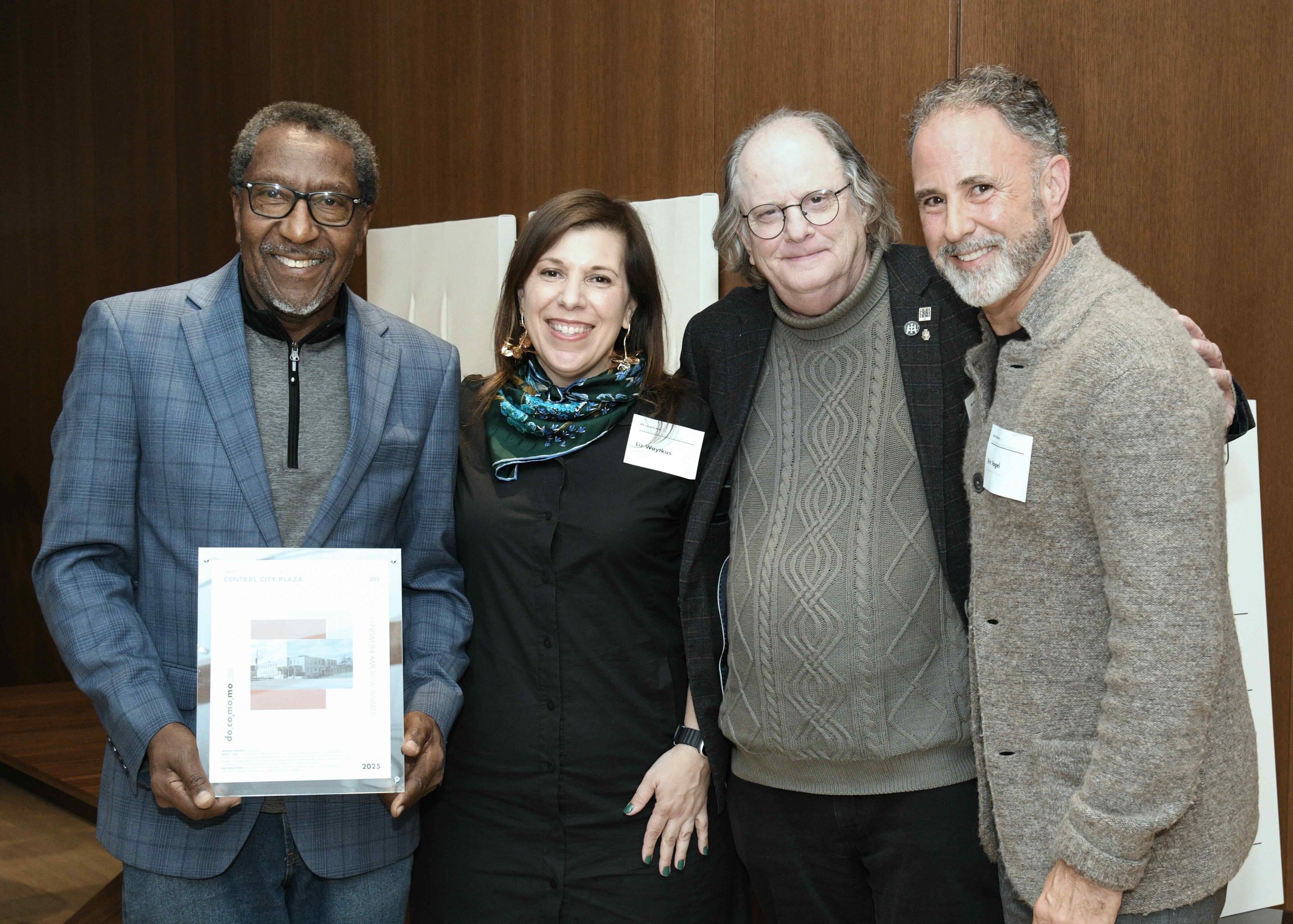
Docomomo US / Modernism in America Awards Ceremony, Chicago. Left to right: Kim Robinson (Docomomo US/Wisconsin Board of Directors), Liz Waytkus (Executive Director, Docomomo US), Chris Rute (Milwaukee Preservation Alliance Board of Directors; Wisconsin AIA), and Eric Vogel (President, Docomomo US/Wisconsin).
Mid-century Modernism had its moment in Milwaukee.
After decades of Depression and wartime shortages, Milwaukee saw a construction boom unknown since the immigrant era. New materials developed for the war effort and even newer ones from the space race fed the need for construction materials and household goods as factories shifted from wartime to civilian production. Between 1930 and 1960, the city’s population grew from 578,249 to its all-time high of 741,324. Architects were kept busy, and innovative structures dotted the area, expressing a new age, today now more than a half-century old, and thus eligible for historic designation.Modernism now has a Movement — and it’s one one that’s gaining traction. In November the Wisconsin chapter of Docomomo US [Documentation, Conservation of the Modern Movement], received two of the national group’s 18 juried 2025 Modernism in America Awards:
- An Advocacy Citation of Merit: Preserving Century City Plaza cited the group’s work to preserve two 1973 Modernist buildings designed by Alonzo Robinson, Wisconsin’s first registered Black architect.
- The first-ever Documentation Student Award for Mothers of Milwaukee Modernism: Building the Layton School of Art [1951-1970], researched, curated and presented by Seth Ter Haar, the Docomomo US/Wisconsin Fellow. Ter Haar was also cited for his work on the modernist sacred places in the Capitol Drive corridor.
According to the chapter’s press release:
Together, these awards mark a watershed moment for Wisconsin, reinforcing the state’s emerging national reputation for community-led preservation, inclusive storytelling, and architectural research.
Milwaukee’s Modernist Heritage Receives “Unprecedented National Recognition”
Central City Plaza
In December 2024 a permit application was made by the Salvation Army, the owner, to demolish and redevelop two buildings designed in 1973 by Alonzo Robinson [1926-2000], Wisconsin’s first registered African American architect. It was Black-designed, Black-owned, and Black-operated — a first for the state. The redevelopment project had not been publicly announced, and time was of the essence if the building was to be saved. Docomomo worked with the Milwaukee Preservation Alliance, whose member Chris Rute, like Robinson a former City of Milwaukee architect, promptly filed a request-for-temporary historic designation, which was granted in mid-January, and later made permanent.
Rute tells Urban Milwaukee:
It was not on anyone’s radar until the owner applied for a demolition permit. The application for temporary and permanent historic designation was submitted just in time to stay the demolition permit. All too often, once a demolition permit has been sought, it is a challenge to change that course. We were lucky this time. Further, we were lucky to have the Salvation Army as the owner. Once they realized the historic significance of the buildings, they made a change to their plans and agreed to save the buildings and the story they told of their period of significance. … In the case of the Central City Plaza, old fashioned reaching out to the leaders of the community was what was done.
According to the jury’s findings:
Through community gatherings, media outreach, public testimony, and formal designation efforts, they re-framed the conversation from a routine development proposal to a recognition of cultural memory and preservation. In a surprisingly quick turn-around, the [Common] Council designated the plaza, and the property owners, Salvation Army, made a new commitment to pause demolition and pursue adaptive reuse in partnership with advocates. … Through public testimony, media outreach, and a push for historic designation, they re-framed the project as an urgent act of preserving Black heritage. Their advocacy strongly influenced the decision by Milwaukee’s Historic Preservation Commission to fast-track historic designation of the site.
According to Liz Waytkus, Docomomo US Executive Director:
“The advocates deserve praise for stepping in quickly, mobilizing the local community, and providing education and context to support the narrative.
According to Todd Grover, Advocacy Committee Chair:
“It is a great example of the many tools people are using not just to win local preservation efforts but to start a larger national conversation about how these histories go unrecognized.”
Mothers of Milwaukee Modernism: Building the Layton School of Art
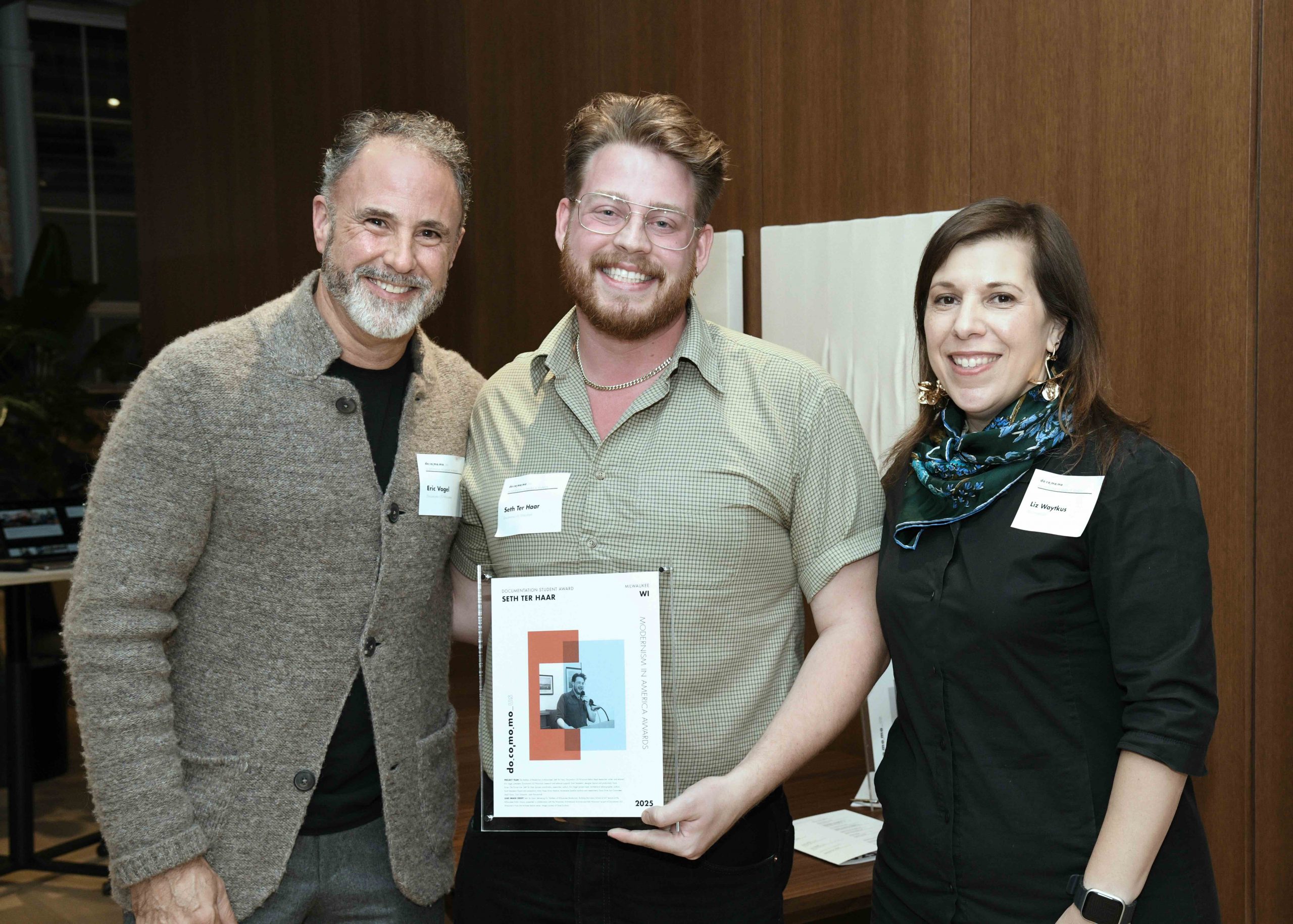
Docomomo US / Modernism in America Awards Ceremony, Chicago. Left to right: Eric Vogel (President, Docomomo US/Wisconsin), Seth Ter Haar (Docomomo US/Wisconsin Fellow), Liz Waytkus (Executive Director, Docomomo US
Seth Ter Haar, a 2023 graduate of the Milwaukee Institute of Art and Design (MIAD), was awarded the first Docomomo US Documentation Student Award for two projects he was involved in this year:
- His study and presentation on the construction of the Layton School of Art, MIAD’s predecessor. The doomed Lakefront building, with its Bauhaus influences, was demolished in 1970 for a never-built freeway; its site remains unbuilt more than a half century later.
According to the award:
This project reconstructs the now-lost 1950 Layton School of Art campus, designed by Jack Waldheim for founders and life partners Charlotte Partridge and Miriam Frink. Using archival research, oral histories, and public programming, it re-frames Layton as a Bauhaus-influenced hub of educational modernism. The project has been exhibited at the Milwaukee Public Library, Milwaukee Institute of Art and Design, Milwaukee Pridefest, and is slated for PBS Wisconsin.
Ter Haar said:
“I’m honored to receive national recognition for my work with Docomomo Wisconsin, especially my research into the Layton School of Art—the predecessor to my alma mater, MIAD. This project helped me explore my own queer identity and build a bridge of pride between the queer femmes who attend MIAD today and those who founded Layton nearly a century ago.”
DocoDrive: The Divine Line
In conjunction with Doors Open Milwaukee, Ter Haar and others created a tour of over 30 mid-century sacred places on the Capitol Drive corridor, where the population was growing rapidly at that time and hyperbolic paraboloid structures supplanted boxes with steeples.
The jury said: “These laudable efforts activate history through engaging programming and show the value of getting young people involved and letting them take the lead.”
The Future of Preservation: Proactive
Milwaukee’s preservation movement scored another victory in November when the Common Council approved a historic designation for the 1909 Miller High Life Theatre [formerly “The Auditorium”] and the 1950 UW-Milwaukee Panther Arena [formerly “The Arena”.] In May it was learned that the Wisconsin Center District, owner of the buildings, had commissioned a long-range study plan to consider, among other things, the development of a large convention hotel complex. The site of the theatre and the arena, across from the Baird Center, would suit the needs.
Officials acted quickly, as Jeramey Jannene reported for Urban Milwaukee. Alderman Robert Bauman was quoted, noting that the designations could be reversed in the future, but it was undeniable the buildings qualified for designation. “Nothing that we will do here will prevent that development,” he said. “The only thing we do here today will create a process.”
As Jannene wrote:
Bauman, who represents the area and serves on the WCD board, said during Monday’s Historic Preservation Commission (HPC) meeting that he nominated the buildings to ensure the public had a voice in any future changes to them. ‘The public should be allowed to weigh in in a transparent, open process, which this designation will facilitate.”
The designation was unanimously approved by the Common Council. When it reached the mayor’s desk in December, he allowed it to go into effect without his signature.
In early December I wrote this to Bauman:
I could envision a scenario where a large scale redevelopment plan would somehow require that, say, the purchase would be contingent on the land being cleared beforehand, etc. I am somewhat wary of the superhotel model, which seems to require stadium-style public financing deals.
His response: “Yes.”
A large convention hotel would likely require a complex financial structuring, something being considered in the study underway, which is expected to be released in January. It may include some public subsidies.
He’s Making a List
Milwaukee architect and historian Eric Vogel is the President of Docomomo/Wisconsin, the 19th chapter of the national organization. He is also the editor of the forthcoming Milwaukee Moderns, a book which will explore many of the buildings in Milwaukee. (Disclosure: I will contribute a chapter on the Prospect Avenue Apartment Buildings of Russell Barr Williamson.) Vogel led a last-ditch, unsuccessful attempt to save the Forest Home Library — an attempt begun only after the demolition permitting was underway.
Vogel writes: “The threat looms large unless we speak up! For God’s sake… in our great city, with so many modern architectural landmarks, the War Memorial, the State Office Building, the Allen Bradley building, the list goes on… none of these are historically designated or protected. What chance is there for Black architects working in Milwaukee’s marginalized communities if we don’t cooperate to sound the alarm?”As Chris Rute of the Milwaukee Preservation Alliance notes: “The new challenge of preservation is protecting the modern and mid-century assets of Milwaukee… the greatest challenge to the preservation community at present, I believe. Unfortunately, they are not always immediately recognized for their historic value…. (O)nce a demo permit application has been made, it is often too late (Forest Home Library is a recent example). I suggest that the preservation community needs to be proactive and identify those buildings of the Modern Movement that are worthy of protection and pursue local designation before plans for their demolition are contemplated. …I agree that there is a cadre of young people interested in historic preservation in general evidenced by the enrollment in the courses on the subject offered at UWM School of Architecture & Urban Planning. Much more still needs to be done regarding those buildings built between 1920 – 1970.”

Existing members must be signed in to see the interactive map. Sign in.
If you think stories like this are important, become a member of Urban Milwaukee and help support real, independent journalism. Plus you get some cool added benefits.


Plenty of Horne
-
Peter Mahler Leaves MSO Board
 Feb 23rd, 2026 by Michael Horne
-
Epstein Was Invited To NYC Fundraiser Featuring Scott Walker
 Feb 7th, 2026 by Michael Horne
-
Milwaukee Man Cited 393 Times in Epstein Files
 Feb 4th, 2026 by Michael Horne