Mandela Barnes Aims to Raise $50 Million in Governor’s Race
Plans to offer a 'unifying message to defeat extremists and extremism.'
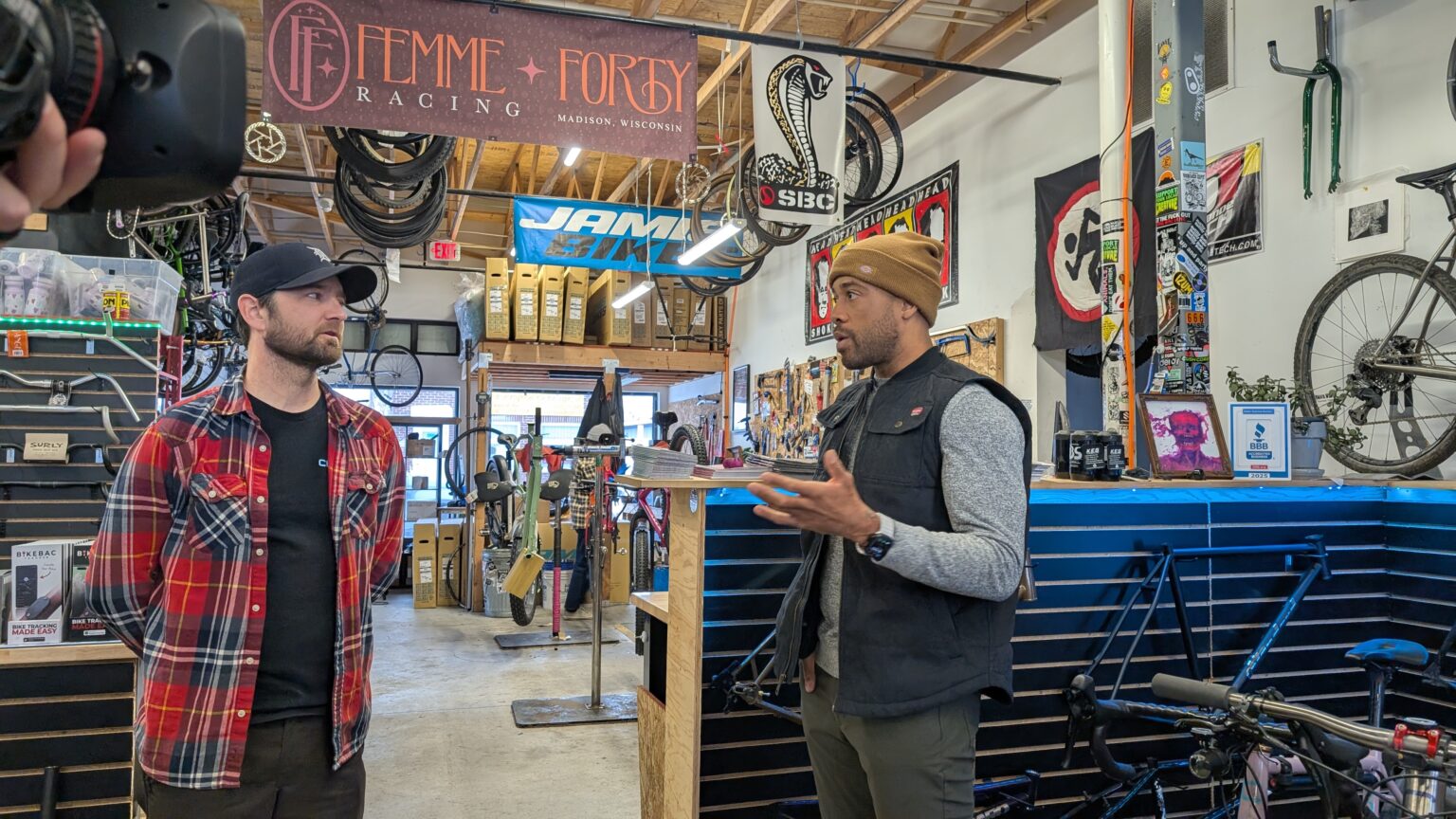
Democratic gubernatorial hopeful Mandela Barnes spoke with bike shop owner Mitch Pilon about rising costs under President Donald Trump and the effects of tariffs. (Photo by Baylor Spears/Wisconsin Examiner)
Even with a crowded Democratic primary field, gubernatorial hopeful Mandela Barnes told reporters Monday that he is focusing his efforts on the Republican candidate he might face in November 2026 and he has raised a “strong haul” in the first week of his campaign.
Barnes, a former lieutenant governor and U.S. Senate candidate, visited Black Saddle Bike Shop (where he said he’s often had his bike serviced) on the North Side of Madison. The stop was part of Barnes’ “Wisconsin Way” tour, launched last week after he announced his campaign. He has joined a field of candidates in the Democratic primary that includes Lt. Gov. Sara Rodriguez, Milwaukee County Executive David Crowley, Wisconsin Economic Development Corporation Missy Hughes, state Sen. Kelda Roys (D-Madison), state Rep. Francesca Hong (D-Madison) and former state Rep. Brett Hulsey.
Barnes said his fundraising so far is “something that’ll make my mom proud,” though he wouldn’t expand on how much money he has raised. He said his goal will be to raise $50 million in the race overall, though he also criticized the need to raise so much.
Barnes noted that during Gov. Tony Evers’ successful second bid for the office, Evers spent around $42 million to defeat Republican businessman Tim Michels, who spent $28.48 million. A record-breaking $164 million was spent in 2022 on Wisconsin’s gubernatorial race.
“It’s not a good sign for things. I wish that were not the case. The goal is to get big money out of politics. The goal is for campaign and ethics reform,” Barnes said, adding that reform is needed at both the state and federal levels. “We should be taking more steps to reduce the impact of money in politics,” he said.
Barnes said the first week of the campaign has been exciting, and he has been trying to talk to as many people as possible. He spoke with bike shop owner Mitch Pilon about rising costs under President Donald Trump and the effects of tariffs.
“With an absence of support from the federal government, even if the state doesn’t have all the resources to make it better, at least staving off some of the worst from happening, I fully believe that’s a responsibility of state government,” he told Pilon, adding that he wants to help “tip the scales back into the favor of working people.”
Pilon, who opened the shop in February 2020, said making ends meet has been a challenge for him and his partner, who is a social worker.
“In Wisconsin, after 10 years, your student loans should be absolved, which they’re not going to be now, and she has a master’s degree… that’s $100,000 in debt at social worker’s compensation,” Pilon said. The Trump administration has sought to upend student loan forgiveness programs this year. “I own a small business. I work really hard… we can’t afford a house.”
“[Trump] promised to lower costs for people,” Barnes told reporters after the conversation. “He said he was going to bring back manufacturing to this country, specifically to this state. It hasn’t happened. As people continue to feel the pinch, tough decisions are being made.”
Barnes said he got into the race because of the urgency of those sorts of challenges.
“It’s a critical moment that calls for leadership. It calls for boldness, to not just take on the president, but to also offer real solutions for the problems that people are facing,” Barnes said. “So this is one of many small businesses that we’ll be showing up to… over the course of this campaign.”
Pilon also asked Barnes about one of the obstacles that his campaign will need to overcome — his failed challenge to U.S. Sen. Ron Johnson in 2022. Barnes has faced pushback to his campaign due to that loss.
“We lost the Senate race…” Pilon said. “How do you get over that? How do you rise above that?”
Barnes responded that he didn’t get into the race for “personal reasons.”
“I got into it because there was work that needed to be done,” Barnes said. “I don’t feel like the job is being done and, alright, that’s a wakeup call to go out there and raise my hand and do the job.”
“How do you change people’s minds?” Pilon asked.
“A lot of it is personal stories and experience,” Barnes said.
It has been rare for candidates in Wisconsin to succeed in winning a statewide race after an earlier loss. Charles Franklin, director of the Marquette Law School poll, found in an analysis of previous governor and U.S. Senate election results that the last time a candidate won one of those statewide campaigns after losing a previous one was in the 1970s. Examples of failed second chances include Tom Barrett, who lost bids for governor in 2010 and 2012, Tim Michels, who lost to Evers in 2022 after he lost a bid for the Senate in 2004, and Russ Feingold, who lost Senate races in 2010 and 2016.
Barnes is undeterred by the precedent.
“There’s a lot of history that would suggest I wouldn’t ever become lieutenant governor,” Barnes said in answer to a question about Franklin’s second-change analysis. “There’s also, you know, in terms of historical precedent, I don’t know that there is a precedent that suggests anybody on the Democratic or Republican side has a better chance of winning.”
Barnes ran for the Democratic lieutenant governor nomination in 2018 in a two-person race, going on to win on the same ticket as Gov. Tony Evers. He was elected and served as the state’s youngest and first Black lieutenant governor from 2019 to 2023.
Wisconsin’s gubernatorial race next year is wide open for the first time since 2010.
During the 2022 Senate race, Barnes became the Democratic nominee after other high-profile candidates dropped out weeks before the primary.
Barnes denied he helped push the other Democrats out of the race then. He also said primaries are good for democracy when asked whether he wants other candidates to coalesce around him.
“I think it should be a battle of ideas, whether it’s a large primary or not, but would never that’s never been my style to try to get anybody out of any race,” Barnes said. “As you know, from the way I got in, I showed up by challenging someone in a primary election, so it’d be very hypocritical of me to suggest anybody get out.”
Barnes previously served in the Wisconsin State Assembly for two terms from 2013 to 2017. He gave up his seat in the state Assembly in 2016 to challenge former State Sen. Lena Taylor (D-Milwaukee). He lost the primary by more than 11,000 votes.
Barnes said his campaign will be focused not just on unifying Democrats but on a “unifying message to defeat extremists and extremism.”
“It does not matter what your favorite ideology might be, there’s a place for you in this campaign because it is about improving quality of life for everybody,” Barnes said.
With about 10 months until the primary, Barnes said he’ll be focused on the Republican candidates in the race. U.S. Rep. Tom Tiffany is the presumed frontrunner for the Republican nomination.
“This is about pointing out flaws and failures, and Tom Tiffany as he stands as the front runner, his failures and leadership, his decisions to go lock-step with the president who has made things worse for Wisconsin,” Barnes said. “Tom Tiffany didn’t go to Washington to make things better for us, and we shouldn’t expect him to improve things for us as governor.”
The primary election is scheduled for Aug. 11, 2026.
Mandela Barnes aims to raise $50 million in governor’s race was originally published by the Wisconsin Examiner.
If you think stories like this are important, become a member of Urban Milwaukee and help support real, independent journalism. Plus you get some cool added benefits.
Political Contributions Tracker
Displaying political contributions between people mentioned in this story. Learn more.